Our family has a lot of teachers. Our daughter is a teacher on a leave of absence to raise her kids. Her husband is a teacher. Our son Matt just married Sarah, who is doing her student teaching this semester. Of course, teachers are not the most well paid group of professionals. We laugh about it sometimes, and tell Matt that since he is the only one in the bunch who is not a teacher, we will depend on him to support the rest of us in our old age.
In fact, though, we all are teachers. Go in any store, parking lot, home, or restaurant, and you will see kids learning from adults. They learn how to act in a civilized manner....or not. They learn to say "please" and "thank you"....or not. They learn to open doors for people....or not. But they are definitely learning. And we are teaching.
Last weekend in Portland, Rachel and Caroline and I ate lunch at Olive Garden. Rachel was 7 months pregnant, her hip was hurting, the day was warm, and by the time we got to the restaurant it was way past lunchtime. Even so, it was crowded, with a predicted 25-minute wait. We took the little pager they gave us and walked outside into the crowd of people. There were all kinds of people sitting on the benches, some older adults, and several young adults with kids of various ages. Rachel stood there in front of everybody, and not one person - not one - offered to give their seat to her. Not one adult suggested to their children to give up their seats for the pregnant lady. I really was surprised. Maybe I shouldn't have been. Maybe I'm just naive and don't know that things have changed and most people are looking out only for themselves. Maybe this world has accepted the status quo for so long that no one notices when a pregnant woman (or elderly woman or man, or handicapped person) needs a little act of kindness.
We were finally driven inside the restaurant by a man who didn't seem concerned or aware that a pregnant woman and everyone else was breathing his cigarette smoke. Again, we stood, and again, no one in this group of people offered her a seat either. Finally a couple was paged that their table was ready, so when they got up, Rachel sat down. There was room for Caroline and me, too.
Then Rachel turned to her daughter and said, "Caroline, you may sit here, but on one condition. If an old person or a pregnant lady like me comes in and can't find a seat, you will have to get up and give them your seat, because that is using your manners. Do you understand?" Caroline nodded. A few minutes later a woman in her 70s or 80s walked in. She leaned against a post while she waited. Rachel bent down to Caroline and said something in her ear. Caroline looked over at the woman and then at me. I took her hand and together we got up and walked over to the lady and offered her our seats. At first she declined, saying thanks for the offer, but she could just stand. We insisted, though, and the lady did indeed walk to the bench, where she sat down beside Rachel.
I doubt if anyone else noticed the whole incident. Probably nobody cared anyway. But Caroline had the opportunity to begin what I'm sure will be a lifetime of learning - about manners, about civility, about empathy, about sacrifice, about what it means to live in community with one another. And if the other children present were learning anything, it was whatever the adults with them were teaching by their actions, or lack of them.
I began this post by saying that our family has a lot of teachers. Well, we have a lot of teachers with degrees, that's true. But I was reminded Saturday that you don't need a degree to be a teacher. The kids are watching.
Thursday, September 15, 2005


Tuesday, September 13, 2005
Coasting
I was riding in our daughter's van the other day, sitting beside Caroline. Rachel wanted to demonstrate Caroline's intelligence (as if I needed a demonstration of what is obviously above normal!), so she was asking her some questions.
"Caroline, what is in your head?" Caroline didn't even pause. "A skull," she said.
"And Caroline, what else is in your head?" Caroline quickly answered, "A brain."
"And Caroline, what does a brain help you do?" Caroline thought for the briefest of seconds, then smiled. "It helps you think...about music and clappin'!" Then she laughed and applauded herself.
Ah, yes. Helps you think. Sometimes we do things by rote because we have always done them that way, not stopping to think that there may be a better and more efficient method out there.
My drive to the hospital where I work is all uphill, and the return trip home is all downhill. The distance is only a few long blocks. Yesterday I was thinking about the high price of gasoline, reviewing ways I could get better mileage, and I had a brilliant idea. I decided to experiment with the drive home. I pressed the gas pedal once to get started out of my parking space, and once more to get through the parking lot. I inched up over a little incline, then coasted down to the street to turn right. Since I had to stop at that point, I had to press the accelerator one more time to start down the street. I then coasted to the next turn, braked slightly to turn right and coasted down that street. The car slowed, then reached a downward incline in which it sped up again, over a short elevated area, then downhill again where I gained speed again. I braked just enough to turn left, then coasted to my driveway all downhill. I turned into my driveway, still without using the accelerator, and braked to enter my garage.
I drive that little drive every day, yet, knowing that it was downhill, I never thought of easing off the gas pedal and just coasting. Now I'm challenging myself to press the accelerator the least amount of times to get home and let gravity do most of the work. It makes me feel like a ball at the putt-putt golf course, trying to gain enough momentum to get over the little bumps, then using gravity to keep the car going until it lands in the garage. Such a simple idea; why haven't I thought of it before?
Having a brain is great. Actually using it - priceless!
"Caroline, what is in your head?" Caroline didn't even pause. "A skull," she said.
"And Caroline, what else is in your head?" Caroline quickly answered, "A brain."
"And Caroline, what does a brain help you do?" Caroline thought for the briefest of seconds, then smiled. "It helps you think...about music and clappin'!" Then she laughed and applauded herself.
Ah, yes. Helps you think. Sometimes we do things by rote because we have always done them that way, not stopping to think that there may be a better and more efficient method out there.
My drive to the hospital where I work is all uphill, and the return trip home is all downhill. The distance is only a few long blocks. Yesterday I was thinking about the high price of gasoline, reviewing ways I could get better mileage, and I had a brilliant idea. I decided to experiment with the drive home. I pressed the gas pedal once to get started out of my parking space, and once more to get through the parking lot. I inched up over a little incline, then coasted down to the street to turn right. Since I had to stop at that point, I had to press the accelerator one more time to start down the street. I then coasted to the next turn, braked slightly to turn right and coasted down that street. The car slowed, then reached a downward incline in which it sped up again, over a short elevated area, then downhill again where I gained speed again. I braked just enough to turn left, then coasted to my driveway all downhill. I turned into my driveway, still without using the accelerator, and braked to enter my garage.
I drive that little drive every day, yet, knowing that it was downhill, I never thought of easing off the gas pedal and just coasting. Now I'm challenging myself to press the accelerator the least amount of times to get home and let gravity do most of the work. It makes me feel like a ball at the putt-putt golf course, trying to gain enough momentum to get over the little bumps, then using gravity to keep the car going until it lands in the garage. Such a simple idea; why haven't I thought of it before?
Having a brain is great. Actually using it - priceless!
Monday, September 12, 2005
Elephants in a Circle

I try to avoid driving at night, because at age 50, my vision takes longer to adjust to oncoming headlights and determine curves in the road. I usually just schedule my life so I am not driving after dark.
This weekend, however, Rachel and Caroline and I went to Portland to buy a nursery rocking chair. Caroline is trying to potty train right now, and this necessitated frequent stops. As luck (or non-luck) would have it, I found myself having to drive back home in the dark. I mentally drove the familiar route as I left Rachel's house. Let's see, there shouldn't be a whole lot of interstate traffic when I'm trying to get in the left lane there...There are stores still open on the highway, so I will have their illumination...Oh no! Construction!
Route 1A is under construction in several places. Orange cones are parked in wavy lines here and there to direct traffic around, over, in between the areas of repair. There are several places with no pavement at all. This area is hard enough to negotiate in the daytime, but at night I knew it would be treacherous, at least for me. I could feel my heart beat faster as I neared the construction zone. I slowed down to let others pass, so there were several cars in front of me as we approached. The cars that passed me were now crawling, not flying. Bumpity bump, bumpity bump, right, then left, then right, then straight, in no apparent pattern or rhyme or reason. Bumpity bump.
I found myself not looking so much at the road itself, or even the fluorescent orange cones. I hypnotically followed the red taillights of the car in front of me. At one curve, I noted there were cars in front of the one I followed. I pictured each driver following the taillights of the one in front of him. (I was in the middle of a large sandwich of cars going 10 mph, and I had nothing to do but philosophize.) Suddenly I got the mental picture of a circle of circus elephants. You can imagine them - each trunk holding onto the tail in front of it and each tail likewise holding onto the trunk behind it. There was no leader, there was no follower, yet everyone was a leader and everyone was a follower. Each depended on the other to be there as part of the chain.
Obviously, as I am writing this, I got home safely. But the elephant picture stuck in my mind.
Ed hates the expression "self-made man." He would say that nobody is "self-made." Every one of us learns from the other, and other people have helped us get where we are today. In turn, we help to show others the way. I am a medical transcriptionist. I never had formal schooling for MT, but I learned as I went. Not on my own, though. I had help, a lot of help. Even if I studied on my own, I had help learning which books to study. I learned about correct format from a more experienced MT who took time to educate me. I learned from an MT web site. I am still learning from people, books that people have written, and the web site where people post. In turn, I have helped MTs in my office learn how to format, how to do research on the Internet, and how to make shortcuts for that ever-elusive line count. We are all followers, all leaders.
I heard by the grapevine that several people whom I do not personally know read my blog on a regular basis. That seemed so strange to me. At first, I wondered why anyone would take perfectly good time to read my rambling words when they have their own life to live. I don't blog so much for "getting published" as for my own introspection, putting my thoughts down so I can make some sense of my life and remember where I am headed. I concluded, though, that if anyone is entertained by this, so be it. If anyone realizes a desire to simplify his/her life by reading this, even better.
We are all in the chain together.
Wednesday, September 07, 2005
Life examples
What is the ideal life? Well, that means different things to different people, I guess. Each person has to answer that question as it pertains to her/his individual experience and dreams. Ed and I have chosen to view our ideal life as one of living simply yet comfortably with less focus on material, tangible things and more concentration on other priorities. To some folks, though, the simple life means working less and having a lot of time to relax every day. Everyone can understand downsizing to a smaller house, or a smaller car, or a less expansive closet. But when the conversation turns more towards purpose, I notice several of my acquaintances become flustered. Isn't the purpose of a simple life to relax? Isn't that what, for example, retirement is all about? What do people mean when they say that they dream of a life of simplicity?
Occasionally on my journey I take time to think about role models for the ideal life. This morning I had a serendipitous experience when I sat down in the early hours of the morning with my cup of hot tea and flipped on the TV for a few minutes. I discovered that I was in the middle of a biography of Rosalynn Carter. What a remarkable lady! Would her life today be described as simple? No, I don't think so. Would it be described as compassionate, fulfilled, full of love, full of contentment, full of purpose? Oh, my, yes! She is one busy woman, and I would find it hard to maintain her schedule even at my age. She is vice chair of The Carter Center, where she functions as ambassador, mediator, human rights and peace promoter. She continues to advocate for mental health reform. She and Jimmy also are heavily involved with Habitat for Humanity and other community-minded endeavors. In addition to this, she is a devoted wife, mother, and grandmother.
Now, be truthful. If you looked back at the list of recent presidential administrations, would you include Jimmy and Rosalynn in the "glamorous" ones? Dazzling? Charismatic? Sophisticated? Elegant? No, they always have considered themselves simple, ordinary people. They are simple. But simple with a purpose. Their ideal life consists of reaching out through their ordinary lives to touch the lives of others in extraordinary ways. For them, simplicity and contentment does not mean relaxing. They are busy people. But they are busy in what counts in life - not busy to make themselves monetarily rich, not busy to make themselves look good. They give to the world and they value their family life. And in doing so they find their purpose.
Then there's my dad. Now, I feel obliged at this point to apologize for again bringing him into my posts, but for those of you who did not know him, you need to realize he was an exceptional human being, which, of course, made him an exceptional husband, an exceptional father, and an exception friend. My story is this:
When my sister and I were teenagers, we had the opportunity to usher for performances at the Auditorium, and after ushering, we were allowed to sit and watch the shows for free. We saw the Metropolitan Opera perform. We saw Fiddler on the Roof and other Broadway shows. We saw the Memphis Symphony Orchestra. We saw Van Cliburn, the concert pianist. All without paying a penny. After every show, late at night, Daddy would drive downtown and pick us up. Knowing he had to get up the next day to go to work or church, he still came. Without ever a complaint. When I became an adult, I would marvel at the sacrifice he had made for us for so many years, something I really didn't appreciate at the time. I asked him once, "Daddy, why did you let us do all that when it was so much trouble for you to get us there and pick us up so late?" He said, "I did it because I knew you girls would have never had the opportunity otherwise to see such things." In a way, doing that made his life more hectic, less simple, but to him his sacrifice had meaning. In the same way, he lived frugally so he could spend money on home movies. He lived frugally so he could give more money to the church and other charities.
Daddy and Rosalynn have one thing in common. It's their desire for simplicity and personal fulfillment and contentment, knowing that the first step is getting their priorities in place.
I want to live simply not for the sake of living simply, but to gain more time for my priorities. By accumulating less, spending more judiciously, and making wise use of time and energy, I am actually freeing up my life for the important things, like relationships. Simplicity is not the goal; it is the tool. It is not the destination; it is the means.
What is the ideal life? I think I'm made some progress answering that question for me. Now it's your turn.
Occasionally on my journey I take time to think about role models for the ideal life. This morning I had a serendipitous experience when I sat down in the early hours of the morning with my cup of hot tea and flipped on the TV for a few minutes. I discovered that I was in the middle of a biography of Rosalynn Carter. What a remarkable lady! Would her life today be described as simple? No, I don't think so. Would it be described as compassionate, fulfilled, full of love, full of contentment, full of purpose? Oh, my, yes! She is one busy woman, and I would find it hard to maintain her schedule even at my age. She is vice chair of The Carter Center, where she functions as ambassador, mediator, human rights and peace promoter. She continues to advocate for mental health reform. She and Jimmy also are heavily involved with Habitat for Humanity and other community-minded endeavors. In addition to this, she is a devoted wife, mother, and grandmother.
Now, be truthful. If you looked back at the list of recent presidential administrations, would you include Jimmy and Rosalynn in the "glamorous" ones? Dazzling? Charismatic? Sophisticated? Elegant? No, they always have considered themselves simple, ordinary people. They are simple. But simple with a purpose. Their ideal life consists of reaching out through their ordinary lives to touch the lives of others in extraordinary ways. For them, simplicity and contentment does not mean relaxing. They are busy people. But they are busy in what counts in life - not busy to make themselves monetarily rich, not busy to make themselves look good. They give to the world and they value their family life. And in doing so they find their purpose.
Then there's my dad. Now, I feel obliged at this point to apologize for again bringing him into my posts, but for those of you who did not know him, you need to realize he was an exceptional human being, which, of course, made him an exceptional husband, an exceptional father, and an exception friend. My story is this:
When my sister and I were teenagers, we had the opportunity to usher for performances at the Auditorium, and after ushering, we were allowed to sit and watch the shows for free. We saw the Metropolitan Opera perform. We saw Fiddler on the Roof and other Broadway shows. We saw the Memphis Symphony Orchestra. We saw Van Cliburn, the concert pianist. All without paying a penny. After every show, late at night, Daddy would drive downtown and pick us up. Knowing he had to get up the next day to go to work or church, he still came. Without ever a complaint. When I became an adult, I would marvel at the sacrifice he had made for us for so many years, something I really didn't appreciate at the time. I asked him once, "Daddy, why did you let us do all that when it was so much trouble for you to get us there and pick us up so late?" He said, "I did it because I knew you girls would have never had the opportunity otherwise to see such things." In a way, doing that made his life more hectic, less simple, but to him his sacrifice had meaning. In the same way, he lived frugally so he could spend money on home movies. He lived frugally so he could give more money to the church and other charities.
Daddy and Rosalynn have one thing in common. It's their desire for simplicity and personal fulfillment and contentment, knowing that the first step is getting their priorities in place.
I want to live simply not for the sake of living simply, but to gain more time for my priorities. By accumulating less, spending more judiciously, and making wise use of time and energy, I am actually freeing up my life for the important things, like relationships. Simplicity is not the goal; it is the tool. It is not the destination; it is the means.
What is the ideal life? I think I'm made some progress answering that question for me. Now it's your turn.
Monday, September 05, 2005
Inside Story
The journey to simplicity and contentment takes a lot of discipline. As I have posted before, the world "out there" is betting that it can influence us to buy products that we don't need, and in the process "buy" into a lifestyle that we would be better off without. To figure out a way out of this mire, we look outside ourselves. We buy books, read magazine articles, search the web, talk to friends and family - all this to accumulate ideas concerning what we are doing right and what we are doing wrong. We especially are on a continual quest for those elusive things called willpower and inspiration. If only, we say, if only we had these, we would be set on this journey. And so we turn over every leaf and every rock, thinking today might be the day we find the pot of gold which holds the strength and wisdom we need. Alas, until we find it, we think, we will just struggle along.
Our daughter Rachel and husband Chris and toddler Caroline lived with us a few months last winter while their house was being built. Any move, of course, is stressful, but when you throw in two families moving in together, family helping you pack, and a toddler in the middle of it all, the stress really accumulates. This house looked overwhelmed with stuff. Caroline, little though she was, came with a bundle of things herself. Her books alone took up half the house. Her child-sized table and chair set was just ripe for tripping over. We kept diapers and wipes upstairs and downstairs...Wee Willy Winky himself would have been exhausted.
In the middle of all the chaos of moving, Rachel discovered she had lost her wallet. This understandably produced some tears and anxiety. She tried to remember when she last used it. I called a restaurant where we ate during the week of the move, but they had not found it. We searched everywhere. After they got settled in, she called to report her credit cards missing, got a new driver's license, and handled all the endless tasks associated with losing one's wallet. She was relieved to find out that the cards were not being used anywhere fraudulently, so she assumed the wallet had dropped into one of the numerous boxes that had been packed and put in the storage unit. There was no way to know for sure, but there wasn't anything that could be done about it other than opening all those carefully taped boxes to check.
In February they moved out.
When spring came, we were doing some cleaning in preparation for selling the house, when I grabbed a grocery store bag out of the corner of the kitchen. I saw some plastic cups inside, and I remembered that this was some stuff we kept unpacked for use on moving day - cups, napkins, some plastic utensils. Oh, and a wallet. Yes, her wallet was here. I called her immediately with the information. Even though it was too late to save her the trouble of changing her credit cards and IDs, it nonetheless was, as they say, "closure."
The wallet had been here all the time. For a week after that, I found myself whispering that phrase. It was unbelievable - right under our noses. If we only had known.
I think in some ways when we pray fervently for wisdom, discernment, self-discipline, and movitation/inspiration for our journey, God just says, "It's already there. I have already given you everything you need. If you become aware that you already have it, you can use it." Yet we still seek outside ourselves what is already in us. It was there all the time. Now we must activate it. The kingdom of God is within you.
Our daughter Rachel and husband Chris and toddler Caroline lived with us a few months last winter while their house was being built. Any move, of course, is stressful, but when you throw in two families moving in together, family helping you pack, and a toddler in the middle of it all, the stress really accumulates. This house looked overwhelmed with stuff. Caroline, little though she was, came with a bundle of things herself. Her books alone took up half the house. Her child-sized table and chair set was just ripe for tripping over. We kept diapers and wipes upstairs and downstairs...Wee Willy Winky himself would have been exhausted.
In the middle of all the chaos of moving, Rachel discovered she had lost her wallet. This understandably produced some tears and anxiety. She tried to remember when she last used it. I called a restaurant where we ate during the week of the move, but they had not found it. We searched everywhere. After they got settled in, she called to report her credit cards missing, got a new driver's license, and handled all the endless tasks associated with losing one's wallet. She was relieved to find out that the cards were not being used anywhere fraudulently, so she assumed the wallet had dropped into one of the numerous boxes that had been packed and put in the storage unit. There was no way to know for sure, but there wasn't anything that could be done about it other than opening all those carefully taped boxes to check.
In February they moved out.
When spring came, we were doing some cleaning in preparation for selling the house, when I grabbed a grocery store bag out of the corner of the kitchen. I saw some plastic cups inside, and I remembered that this was some stuff we kept unpacked for use on moving day - cups, napkins, some plastic utensils. Oh, and a wallet. Yes, her wallet was here. I called her immediately with the information. Even though it was too late to save her the trouble of changing her credit cards and IDs, it nonetheless was, as they say, "closure."
The wallet had been here all the time. For a week after that, I found myself whispering that phrase. It was unbelievable - right under our noses. If we only had known.
I think in some ways when we pray fervently for wisdom, discernment, self-discipline, and movitation/inspiration for our journey, God just says, "It's already there. I have already given you everything you need. If you become aware that you already have it, you can use it." Yet we still seek outside ourselves what is already in us. It was there all the time. Now we must activate it. The kingdom of God is within you.
Friday, September 02, 2005
Coming back again
As usual, my daily e-mail meditation gave me food for thought:
The man who succeeds in his inner exploration is the man who comes back. He comes back to more of the lessons he must learn. He returns in spite of discouragement, in spite of hearing blunt facts about himself. Some people do not come back. They go away sorrowfully or critically, therefore losing what could have saved them. We must be different. We must come back, a thousand times if necessary, until we reach the harbor we sense is beyond the fog.
Vernon Howard
Secrets for Higher Success
Our journey, as I have mentioned before, is a great deal more about the mind than about actions. It is returning our brains again and again to focus on the goal, the little steps, the big steps - facing frustration and disappointment, which invariably brings the uneasiness of second-guessing ourselves. Introspection is not comfortable. It is usually very uncomfortable. Yet the lessons need to be learned. And some of us are more stubborn than others.
We have seen this week how the hurricane has forced our country to do some introspection on subjects of race relations, poverty, preparedness, and need. This is in some ways paralleling our own personal introspection as we feel the first tease of autumn in the air and know some important decisions need to be made about our house. We have similar questions: Are we prepared for a change in plans? Are we willing to think ahead? Are we aware of the "what if" scenarios? Can we change our actions to fit the needs? Can we accept the change in plans that seems necessary and throw our full weight into implementing those plans?
We picked a very bad time to try to sell our house, especially now. It didn't help that the first few months the house was on the market were essentially lost because there was no advertising, for instance. Now that gas prices are soaring, everyone knows the home heating oil prices are next on the agenda, and some leaves on the tree at the end of our street have already turned a bright red orange. The leaves were inaudible but they might as well have been shouting, "Fall is almost here! Winter will follow! See that Victorian house for sale down the street? It is huge! It will cost a fortune to heat! Don't even think about it!"
In addition to the problem of selling the house, we have the other problem of running out of time to build the next house. They don't build much in the middle of a Maine winter.
So we have come to the realization (working on acceptance) that we will be spending another winter in this house. Basically the house will not be actively marketed until spring. In some ways, this will be a mighty challenge, because heating oil prices will probably be double those of last year, and we will have to make more sacrifices in other spending, as well as turning off some radiators and shutting off rooms. Ed has not sawed or split wood this summer, as he usually would have been doing, because we thought we would be spending this winter in our new house. So now he has to play catch-up. I am sure wood prices will soar too because the demand will be so high.
Staying here also involves our going to the storage unit and bringing back everything we took over there a few months ago - boxes and boxes and boxes. Heavy boxes. Then all of our hard work emptying the house and "staging" will be reversed. We will have boxes everywhere again.
In a way, this is a good thing - staying here this winter. I have been feeling in limbo so long that I haven't let myself do much except clean house and worry. Now I can relax just a little and work some projects.
But fall is also a dangerous time of year for us because we are evaluating our wardrobes again, and seeing what we might need for winter. (Ed has created the most remarkable guilt-free means of buying new clothes: He's lost so much weight his clothes don't fit anymore.) Meanwhile, the fall clothes catalogs keep coming and even the Christmas catalogs are here. $$$$ This will be the first Christmas since our determination to simplify and modify. It will also be the first Christmas we will have had two grandchildren. It's a veritable obstacle course on the road to simplicity!
And so we dutifully are reminded that the time for introspection has come. What have we discovered? Could we have done more? Did we make wise decisions? I believe they call it the "shoulda/coulda" syndrome. Now fall is on the doorstep. And the journey to simplicity continues. Through the frustration, through the disappointment, through the temptations, through the worry - we walk. Through the realization that we are so much better off than many others - we walk. Through fear of the unknown with "cautious optimism" we walk.
And hopefully we learn.
Wednesday, August 31, 2005
Always the Questions
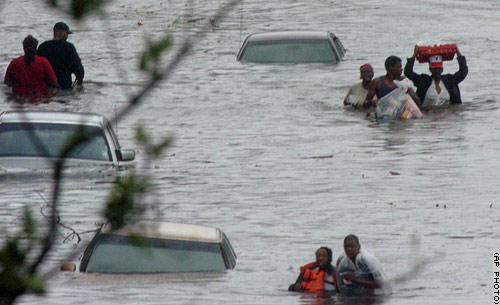
(Photo from CNN)
I wonder what is going through the minds of these victims. Mostly they are just trying to survive right now, but in the future when they are, hopefully, back to a relatively normal life, they might be thinking along the same lines as I have been thinking since February, when I started this blog. They will have to come to their answers, as I have to come to mine.
This experience will have affected them in a major way. To be able to come to terms with it - physically, mentally, emotionally, and spiritually - will undoubtedly be a enormous project. Though I am not affected by the hurricane physically, it does give me pause to ask myself again the questions of my life, the questions and thoughts that have developed repeatedly as I have written about the journey to simplicity:
- What is precious to us in this life? What do we cherish? When it comes down to the nitty gritty, what is it we would try to save in an emergency? What is replaceable? What is not?
- What can I control in my life? What is out of my control? Do I know the difference? Do I have the ability to accept that which I cannot change while changing the things I can?
- Quote from March: The expression comes to my mind, "You wouldn't understand." "You had to be there." I think that says it all. As horrible as the images are on TV, we know we are only living vicariously through these victims. I have no idea what it would be like to suddenly have your existence reduced to a garbage bag of food and a blanket.
- How much "stuff" have I accumulated when there are so many people who don't have the basics of food and shelter?
- How much have I taken for granted in my life (house, family/friends, job, good health, etc.)?
- Quote from May: For awhile, however, I have been considering the waste we generate, as a family and as a society. Sometimes we don't think about it until we see the sewers are backing up, or we are thousands of people living in the Superdome.
- How much does it take for us to survive? To live sufficiently? To live comfortably? To live well? To live in a way to which we have become accustomed? What can we do without? What do we need? What can we share? How do we justify our lifestyle in the face of poverty and hunger?
Thursday, August 25, 2005
Look up!

Sometimes all it takes to advance a few steps in the journey to simplicity is a change of perspective.
When I was a little girl, one of my favorite pastimes was to lie on the bed, look up at the ceiling, and pretend the ceiling was the floor of the room. I tried to imagine myself coming into the room, stepping over the door frame, and moving about the room in a whole new way. I could "look up" and see furniture hanging from the ceiling! I must have mastered this feat of imagination during my many required naps. (If Mama thought we were actually sleeping during those times, she was quite mistaken.) In another room, which we used as a bedroom at the time, we had one of those acoustic ceilings made of tiles with little dots all over them. Whenever I would find myself trapped in a nightmare, I would subconsciously try to wake up by forcing my mind's eye to see those dots, and all of a sudden I would really be awake, staring at the ceiling.
I think we spend a lot of time looking up when we are young. After all, we're little. We have to look up to see people's faces, to see on top of tables, to peer over the church pew in front of us, to watch the Christmas parade.
Now that I am an adult, I find myself mostly looking down. Now, there are perfectly good reasons for this. I am short, for one thing. Not quite as short as my sister, but short nonetheless. (Well, I'm two years older than she is, which she won't let me forget, and I have to remind myself that she too has shortcomings...oops, there I go again...sorry, Joy!) Because I am, as they say, vertically challenged, I find it easier to spot dog hair on the floor than cobwebs on the ceiling. When we clean the house for showings, I have to remind myself to look up and check the ceilings, corners, and tops of the walls for places that need dusting.
I also think my habit of looking down is a result of my tendency to trip over things. Lord knows I need all the awareness I can muster to compensate for my apparent neurological deficiencies.
This morning, I took our dog Babe outside before I went to work. It was dawn, still rather dark. While she was smelling some exciting scent in the yard, I looked up. It was an ordinary night sky, yet it was extraordinary in that moment to me. The glowing stars appeared as if they had been randomly flung across the heavens, but I knew that there were constellations and patterns, and I realized for just a few seconds that I was looking at the same stars people had seen countless years ago. For a few minutes I had forgotten I was in my yard in Maine, trying to keep Babe from unearthing a skunk somewhere. For just a few minutes I had glimpsed the awe-inspiring size of our part of the galaxy, and realized my struggles for simplicity were, in one way, totally unrelated to the scheme of things - and yet, in another way, they were joining my spirit to that of the universe. And the ceiling was the floor, and the floor was the ceiling, and they all blended together. I must really look up more often.
Monday, August 22, 2005
Know what you want
I think one of the most difficult tasks I have encountered in the journey to simplicity is trying to discern what I want. What I really want. It seems easy enough, doesn't it? It should be. But as I mentioned before, companies spend billions of dollars a year in advertising, trying to convince me that what I want is what they've got. Friends and acquaintances can influence me. And (I hate to admit it) sometimes I want to just "buy something" because I had a bad day, and darn it, I deserve it, whatever it is.
If I ever wanted to follow in my dad's footsteps, it is in this area. Daddy was very sure of what he wanted and what his priorities were. Every year a few weeks before his birthday, September 1, I would try to figure out something creative to give him, not the same old stuff. And every year, he would ask for the same old stuff. "You know what I want," he would say, with twinkle in his eye. "Ties, page protectors, and cashews." What a puny list!
And how did he come up with the (to me) boring "Big Three"?
In my opinion neckties have been maligned as one of the most unimaginative gifts ever. The kind of gift a man opens and says, "Uh...yes, thanks...I guess." Not Daddy. He was required to wear ties at his job at the bank, and he rarely bought any for himself, so he really wanted ties. No kidding!
Also one of his hobbies was writing letters and in the course of that, he received many letters in return. Some were from famous people; others were from people who were not generally known. Bishop or paper carrier - it didn't matter to Daddy. Each letter was precious to him and he kept them all in notebooks, each letter gently slid into one of those plastic page protectors. The protectors were fragile and sometimes needed to be replaced, but mostly he wanted more because he had so many more letters to document and save.
Then there are the cashews. The nirvana of nuts. Now me, if I want some cashews, I'll pick up a can at the grocery store. Not Daddy. They were expensive, and he did not spend that kind of money on himself. He was wholly dependent on his family to provide him with a can of the delectable snack whenever gift-giving time rolled around. The rest of the year he was content to enjoy Seessel's butter pecan ice cream and Aunt Bessie's peanut brittle. But his delicious cashews were a joy for him to receive. They were one of the "big three" on his list.
Well, being stuck with a wish list from him that short just made me frustrated. I usually made him a card, but I still felt a letdown when the gift that accompanied a creative homemade card was one or two of the "big three." Ties, page protectors, and cashews. But do you know what? Daddy didn't feel the need to beat around the bush. He knew exactly what he wanted. And it was worth it to see his eyes light up when he opened another tie, another box of page protectors, and one more can of cashews.
I hope we all can learn from my dad. Don't waste money, don't accumulate a lot of things you really don't care about. When you are the gift giver, find out what someone truly wants, even it sounds dull to you. And if you are the lucky recipient, think long and hard about what is important to you. Go for your version of the ties, the page protectors, and the cashews. Your smile will be genuine and you will be one more step closer to contentment!
Thursday, August 18, 2005
Lincoln meets World War II
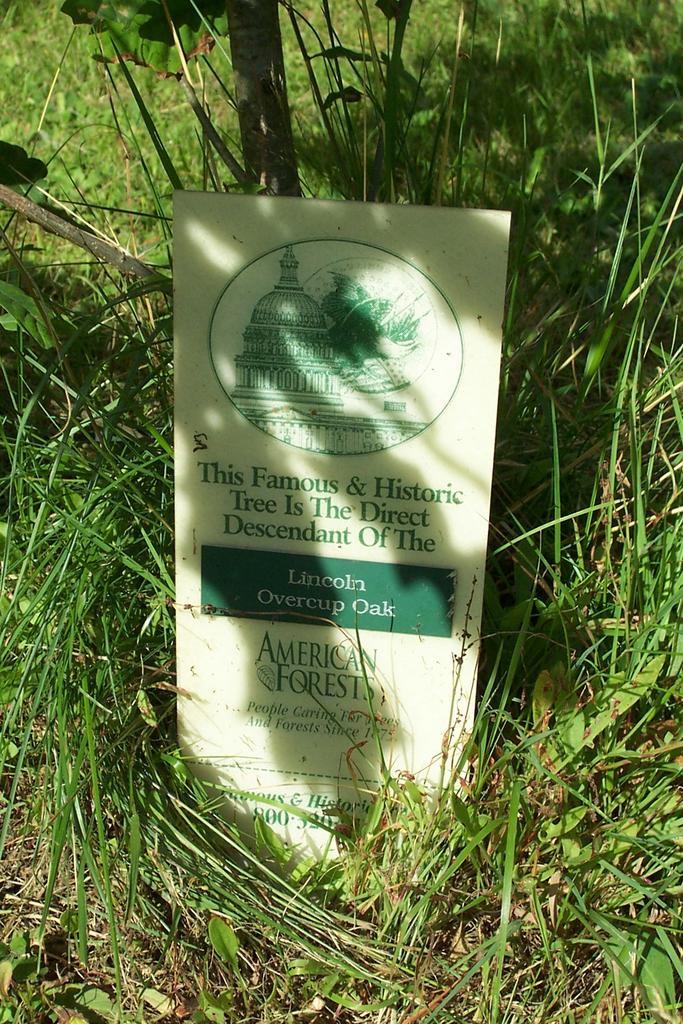

A few years ago, my sister sent me a unique gift for my birthday. It was a young tree, an oak which is a direct descendant of the giant oak that marked the area of Abraham Lincoln's birthplace.
I was surprised to discover that through this company one can order trees descended from the properties of many famous people. Here's a list of some of the categories of tree owners they offer: American Presidents, American Revolution, Environmentalists, Native American, African American, Civil War, Famous Women, Military Heroes, Adventurers, Authors and Artists, Inventors and Science, Texas, Landmarks, and Children's Favorites. By golly, that should cover everyone's interests! They even have a new offering - Anyone want a descendant of a tree from Elvis's Graceland in Memphis?
Well, my sister, who knows every possible thing about me and my obsessions, appropriately sent me the Lincoln tree. It even came with a plaque of certification. We planted the tree in the yard and stuck the plaque in the ground beside it. Every Maine winter it lies dormant, and every spring when all the other trees are in bloom, the Lincoln tree still sleeps. Every spring we think that at last the poor Kentucky tree has succumbed to the harsh Maine winters. Then every July, when we have just about lost hope, the first leaves appear on the Lincoln tree and soon it looks vibrant again. So far, so good!
We've been joking about the tree lately because our Realtor, Diane, has taken a liking to mentioning the Lincoln tree when she takes people on tours of our house. At a showing a few weeks ago, the clients, Diane, Ed and I had congregated on the porch after the tour when Diane said, "Oh, yes, I forgot to mention the famous Lincoln tree from Lincoln's birthplace!" She pointed into the yard. The man scanned his eyes across the yard, seeing lots of mature trees, of course. "Which one is it?" he asked. "That one!" said Diane, trying to point in a clearer way. "Which one?" the man asked again, squinting through the afternoon sun. At that point, Ed offered to take the man across the yard so he could see the tree up close. When the man finally was shown the tiny young tree, he laughed. He had thought she had said something about a tree that was planted when Lincoln was born. Well, when people are searching for a tree, they assume the tree is taller than they are - especially if they think it is almost 200 years old!
Yesterday we had another showing. A courteous Japanese family was thinking of buying the house. They were so courteous they didn't even take any of the cookies and water we had on the table for them. (Nobody had actually encouraged them to partake, and I think they were too polite to assume that the refreshments represented our little attempt at hospitality.) They did not seem very fluent in English; we didn't know any details of how long they had been in the country, etc., but they really liked the house, which pleased us. We are glad they felt comfortable here and we hope they liked it enough to buy it. Later that night at dinner, I remarked to Ed, "Oh, no - they didn't get to see the Lincoln oak! Oh well, they might not know who Lincoln was." To which Ed thoughtfully remarked, "At least it isn't a Truman elm."
Wednesday, August 10, 2005
Who am I? Where am I?
I had strange dreams two consecutive nights. Ed interprets dreams, but these I could figure out on my own.
In the first dream, I was back in high school. Actually, that's a nightmare, not a dream. I have school nightmares a lot, and in them I am usually late for class or forgot something important. Anyway, in my first dream, I was in a school where the students had to wear ID badges at all times, and I had lost mine. I dug through my purse frantically trying to find my badge, but never could find it.
In the second dream, I was out somewhere and had to call Ed to ask him for directions on how to get home, because I had forgotten where I lived. Not that I was lost, mind you. I had simply forgotten where I lived! Later in the dream, I found myself at my childhood church singing in the choir. Someone asked me why I had tennis shoes on. I told him, "It's because all my other clothes are packed away in storage."
See? Easy to interpret! These dreams boil down to "Who am I?" and "Where am I?" with an added footnote of "How come everything I need is in storage?" My whole identity is undergoing review and revision during this downsizing. And my subconscious is starting to wonder where in heck I'm supposed to be living. In other words, transition anxiety in my life has become ubiquitous - even in sleep I am stressed!
In the first dream, I was back in high school. Actually, that's a nightmare, not a dream. I have school nightmares a lot, and in them I am usually late for class or forgot something important. Anyway, in my first dream, I was in a school where the students had to wear ID badges at all times, and I had lost mine. I dug through my purse frantically trying to find my badge, but never could find it.
In the second dream, I was out somewhere and had to call Ed to ask him for directions on how to get home, because I had forgotten where I lived. Not that I was lost, mind you. I had simply forgotten where I lived! Later in the dream, I found myself at my childhood church singing in the choir. Someone asked me why I had tennis shoes on. I told him, "It's because all my other clothes are packed away in storage."
See? Easy to interpret! These dreams boil down to "Who am I?" and "Where am I?" with an added footnote of "How come everything I need is in storage?" My whole identity is undergoing review and revision during this downsizing. And my subconscious is starting to wonder where in heck I'm supposed to be living. In other words, transition anxiety in my life has become ubiquitous - even in sleep I am stressed!
Friday, August 05, 2005
The hot seat
I find most peace in my life when I try to live by the Serenity Prayer, which I mentioned many posts ago. In short, this familiar prayer urges us to control the things we can, let go of the things we can't control, and to have the wisdom to know the difference in these two categories.
That simple philosophy of life has really been helpful to me - up until now. Up until now, the control I managed to acquire gave me a sense of empowerment over my own life. This week I was asked to have control over someone else's life...and I didn't like it, not one bit.
I have been experiencing my first few weeks of jury duty. Actually, the judge said they call it "jury service" now to make it seem more palatable. They want us to think we are volunteering, when in actuality we are being drafted.
No matter - I didn't try to avoid it. I had reached the ripe old age of 50 and had never been called to serve on a jury, probably because we spent so little time in one place as we were moved around in the ministry. I was intrigued by the courtroom. I had never seen a real jury in action. I had minor trepidation in the midst of all this curiosity and anticipation, though, because I have always considered myself to be - well, not exactly wishy-washy, but I try to give both sides on any argument equal time and if the area is gray and not black and white, I find it hard to make up my mind. In one way, that qualifies me exceedingly well for a jury, but in another way, I'm a jury's worst nightmare. See? Even in discussing this, I see the gift and the curse in thinking this way!
The judge told us we were released from confidentiality about our participation in the cases after the fact, so I feel free to mention a few things here. The first case was not that important. A young man was visually identified by a state trooper as driving a car when he had been suspended from doing so. Sounded pretty clear-cut. Then we found out the trooper saw him only in passing, and waited 6 days to issue the summons, at which time the young man and his girlfriend swore it must have been someone else. It would have been an easy case if the officer had pulled him over immediately, but...we had to find him not guilty because there was too much doubt.
I didn't lose any sleep over that case.
The next case was rape. Suffice it to say, most of the jury figured the guy did it, but, for reasons I will not address here, he got off too.
I started losing sleep.
Then came the most recent case. This was a 65-year-old man accused of inappropriate sexual contact (touching through clothes) with a couple of girls, 8 and 9 years old. The state's case was weak - his word against theirs. There apparently was some tickling going on and the defendant, a small-statured old man with a mustache, balding head and bowtie, insisted if the touching happened at all, it was incidental. No witnesses. No evidence. We just had to sit there and make a grave decision - whether to send this man to jail and in the process give him the legal requirement to register as a sex offender for the rest of his life.
We agonized. We almost became a hung jury, but the holdouts who thought he was guilty decided to change their verdict because a hung jury would have required the girls to go through another trial. It had already been a year since this happened in the first place. Everyone involved in the case, even secondarily, had been under this cloud for a year to have their day in court. And, Lord help me, I was one of 12 people who were commissioned to decide the verdict.
That threw the Serenity Prayer out the window temporarily for me. It's easy to say, "Control the things you can," but it's not easy to come to a decision - with very, very little to work with - that will affect lives forever in a huge way. The pressure was enormous.
The verdict after 2-1/2 hours of deliberation was not guilty. It was decided we just didn't have enough evidence to say this man did it. Did he do it intentionally? Accidentally? Did the girls have a skewed perception of what happened? If he was innocent, we cursed the defendant for being stupid enough to put himself in a position of vulnerability. If he was guilty, we doubly cursed him for doing such a despicable thing. As a jury, we were certainly in a cursing mood.
I can say for sure most of the jury had a restless night after that. Did we save an innocent old man from being labeled for life and going to jail? Or did we let a potential child molester out to prey again?
There is not much serenity about being on a jury.
That simple philosophy of life has really been helpful to me - up until now. Up until now, the control I managed to acquire gave me a sense of empowerment over my own life. This week I was asked to have control over someone else's life...and I didn't like it, not one bit.
I have been experiencing my first few weeks of jury duty. Actually, the judge said they call it "jury service" now to make it seem more palatable. They want us to think we are volunteering, when in actuality we are being drafted.
No matter - I didn't try to avoid it. I had reached the ripe old age of 50 and had never been called to serve on a jury, probably because we spent so little time in one place as we were moved around in the ministry. I was intrigued by the courtroom. I had never seen a real jury in action. I had minor trepidation in the midst of all this curiosity and anticipation, though, because I have always considered myself to be - well, not exactly wishy-washy, but I try to give both sides on any argument equal time and if the area is gray and not black and white, I find it hard to make up my mind. In one way, that qualifies me exceedingly well for a jury, but in another way, I'm a jury's worst nightmare. See? Even in discussing this, I see the gift and the curse in thinking this way!
The judge told us we were released from confidentiality about our participation in the cases after the fact, so I feel free to mention a few things here. The first case was not that important. A young man was visually identified by a state trooper as driving a car when he had been suspended from doing so. Sounded pretty clear-cut. Then we found out the trooper saw him only in passing, and waited 6 days to issue the summons, at which time the young man and his girlfriend swore it must have been someone else. It would have been an easy case if the officer had pulled him over immediately, but...we had to find him not guilty because there was too much doubt.
I didn't lose any sleep over that case.
The next case was rape. Suffice it to say, most of the jury figured the guy did it, but, for reasons I will not address here, he got off too.
I started losing sleep.
Then came the most recent case. This was a 65-year-old man accused of inappropriate sexual contact (touching through clothes) with a couple of girls, 8 and 9 years old. The state's case was weak - his word against theirs. There apparently was some tickling going on and the defendant, a small-statured old man with a mustache, balding head and bowtie, insisted if the touching happened at all, it was incidental. No witnesses. No evidence. We just had to sit there and make a grave decision - whether to send this man to jail and in the process give him the legal requirement to register as a sex offender for the rest of his life.
We agonized. We almost became a hung jury, but the holdouts who thought he was guilty decided to change their verdict because a hung jury would have required the girls to go through another trial. It had already been a year since this happened in the first place. Everyone involved in the case, even secondarily, had been under this cloud for a year to have their day in court. And, Lord help me, I was one of 12 people who were commissioned to decide the verdict.
That threw the Serenity Prayer out the window temporarily for me. It's easy to say, "Control the things you can," but it's not easy to come to a decision - with very, very little to work with - that will affect lives forever in a huge way. The pressure was enormous.
The verdict after 2-1/2 hours of deliberation was not guilty. It was decided we just didn't have enough evidence to say this man did it. Did he do it intentionally? Accidentally? Did the girls have a skewed perception of what happened? If he was innocent, we cursed the defendant for being stupid enough to put himself in a position of vulnerability. If he was guilty, we doubly cursed him for doing such a despicable thing. As a jury, we were certainly in a cursing mood.
I can say for sure most of the jury had a restless night after that. Did we save an innocent old man from being labeled for life and going to jail? Or did we let a potential child molester out to prey again?
There is not much serenity about being on a jury.
Monday, August 01, 2005
Self
My e-mail meditation for the day:
The difference in then and now is that those times represented involuntary simplicity as opposed to voluntary simplicity. We didn't have much back then because we just didn't have much - not because we chose to be frugal. We had to.
Now we are trying to change our mindset to voluntarily live a life of simplicity. It's easy to pass up a purchase when you can't afford it. It's much more difficult to pass up the same purchase when your wallet has enough money, but your mind realizes you don't really need the item.
The journey to simplicity is one we take as a chosen decision and goal, not because circumstances force us to. And part of that journey is "death to the old self" in order to find a new life within us.
When we transcend ourselves and become in our ascent towards God so simple that the bare supreme Love can lay hold of us, then we cease, and we and all our selfhood die in God. And in this death we become the hidden children of God, and find a new life within us.
Jan van Ruysbroeck
The Sparkling Stone
To transcend one's self. To rise above the bad habits that have been ingrained in us since we started earning money and our choices were much more independently made. I can look back and see when we lived a more frugal life. I remember when we used card tables pushed together for a dining room table. I remember making most of my own clothes. I remember when eating out was a special occasion, not a last-minute decision. I remember life with one TV and - gasp - even one phone!
The difference in then and now is that those times represented involuntary simplicity as opposed to voluntary simplicity. We didn't have much back then because we just didn't have much - not because we chose to be frugal. We had to.
Now we are trying to change our mindset to voluntarily live a life of simplicity. It's easy to pass up a purchase when you can't afford it. It's much more difficult to pass up the same purchase when your wallet has enough money, but your mind realizes you don't really need the item.
The journey to simplicity is one we take as a chosen decision and goal, not because circumstances force us to. And part of that journey is "death to the old self" in order to find a new life within us.
Saturday, July 30, 2005
Toenails
Wouldn't it be great if you could make a decision about simplifying once and for all - and it happened? That would be as great as making a one-time decision to give up junk food and never have to think about it again! Why can't things be like tattooing? You make a decision to have a tattoo, it's done, and it's over with and "activated" for the rest of your life.
The journey to simplicity, unfortunately, it not like tattooing. It is one major decision, carved out into little pieces of decisions day after day after day. Sometimes you stop on the journey, sometimes you actually lose ground, and other times you're full speed ahead. But it's a journey, nonetheless, and demands the mental and emotional focus of a journey. We may take a "break" but we cannot afford to "wander off" into the woods and forget about the trip altogether.
It's actually difficult to blog about the journey, because, using the sacramental words of the liturgy, it is an "outward and visible sign of a inward and spiritual [change]." Some of the changes are easy to write about, and some are still percolating on the stove like one of Ed's pots of delicious soups. "Is it ready?" I ask him impatiently, not being a cook myself and not knowing the signs that something is finished. Ah, it may be edible but not necessarily ready.
Which brings me to toenails. Yesterday I spent a few precious hours with 2-year-old Caroline, who was her usual precocious self. Our daughter, whose new house has no grass in the yard yet, requests that guests remove their shoes inside, so on this particular day I was walking around barefoot, following little Caroline, who was trying to show me where her "arts and cafts" box was so we could do some painting. At one point, Caroline turned to me, looked down at my feet (she always seems to have an obsession with feet!) and her eyes widened. "Gammy!" she said in awe. "YOU HAVE TOES!"
Now I want to assure the reader that I am anatomically similar to all other human beings in that yes, I have toes, I have always had toes, and Lord willing I will have toes the rest of my life. Her excited observation startled me for a minute. Caroline has seen my toes, hasn't she? Haven't I taken naps with her? Haven't I worn sandals in front of her? It took me the rest of the day to realize what had happened. She had seen my toes before, but my toenails were now painted with nail polish. I had done that this month to "spruce up" for Matt's wedding, and I realized she had never seen them colored before. She knew in her mind that I had always had toes, but something was different, and with her advanced but still limited vocabulary, the only way she could express her newly found insight was "YOU HAVE TOES!"
The journey to simplicity has been full of these "aha" experiences, hard to blog about but important nonetheless. Sometimes the words just can't convey the depth of things we are discovering about ourselves, our lifestyle, our wants, our needs, the lessons we are handing down to the next generation, and the attitude we are presenting to the world as a society. But these experiences, like the soup, can percolate for awhile. And every once in awhile, I can lift the top of the pot and breathe in a most heavenly smell, and exclaim in awe, like Caroline, "WOW!"
The journey to simplicity, unfortunately, it not like tattooing. It is one major decision, carved out into little pieces of decisions day after day after day. Sometimes you stop on the journey, sometimes you actually lose ground, and other times you're full speed ahead. But it's a journey, nonetheless, and demands the mental and emotional focus of a journey. We may take a "break" but we cannot afford to "wander off" into the woods and forget about the trip altogether.
It's actually difficult to blog about the journey, because, using the sacramental words of the liturgy, it is an "outward and visible sign of a inward and spiritual [change]." Some of the changes are easy to write about, and some are still percolating on the stove like one of Ed's pots of delicious soups. "Is it ready?" I ask him impatiently, not being a cook myself and not knowing the signs that something is finished. Ah, it may be edible but not necessarily ready.
Which brings me to toenails. Yesterday I spent a few precious hours with 2-year-old Caroline, who was her usual precocious self. Our daughter, whose new house has no grass in the yard yet, requests that guests remove their shoes inside, so on this particular day I was walking around barefoot, following little Caroline, who was trying to show me where her "arts and cafts" box was so we could do some painting. At one point, Caroline turned to me, looked down at my feet (she always seems to have an obsession with feet!) and her eyes widened. "Gammy!" she said in awe. "YOU HAVE TOES!"
Now I want to assure the reader that I am anatomically similar to all other human beings in that yes, I have toes, I have always had toes, and Lord willing I will have toes the rest of my life. Her excited observation startled me for a minute. Caroline has seen my toes, hasn't she? Haven't I taken naps with her? Haven't I worn sandals in front of her? It took me the rest of the day to realize what had happened. She had seen my toes before, but my toenails were now painted with nail polish. I had done that this month to "spruce up" for Matt's wedding, and I realized she had never seen them colored before. She knew in her mind that I had always had toes, but something was different, and with her advanced but still limited vocabulary, the only way she could express her newly found insight was "YOU HAVE TOES!"
The journey to simplicity has been full of these "aha" experiences, hard to blog about but important nonetheless. Sometimes the words just can't convey the depth of things we are discovering about ourselves, our lifestyle, our wants, our needs, the lessons we are handing down to the next generation, and the attitude we are presenting to the world as a society. But these experiences, like the soup, can percolate for awhile. And every once in awhile, I can lift the top of the pot and breathe in a most heavenly smell, and exclaim in awe, like Caroline, "WOW!"
Friday, July 29, 2005
OK, I get the idea
There are many ways to learn how to create and maintain a life of tranquility and simplicity. You can read my blog, for instance! :) Or you can read the innumerable books that are published every year - books with names like Voluntary Simplicity (rev) : Toward A Way Of Life That Is Outwardly Simple, Inwardly Rich...Choosing Simplicity: Real People Finding Peace and Fulfillment in a Complex World...Simplicity Lessons: A 12-Step Guide to Living Simply...The Circle of Simplicity: Return to the Good Life.
Or, you could just have a lightning storm hit your local electricity supplier for a few hours.
Yes, we got a crash course in living simply this week. Basically, life without electricity will bring home what living simply really means. Candles provide nice ambience when you want to have a romantic dinner - but they are quite useless for reading a magazine. There is an eerie quiet about the house when suddenly the lights go out, the fans go off, the refrigerator stops working, the TV turns itself off, and all you can hear are the wall clocks which run on batteries ticking in the silence. Motions you are used to doing automatically - turning on the light switch when you enter a room, for instance - are fruitless. Trying to find something to eat for dinner is a challenge in itself. (We ended up with cheese and bread and a little deli turkey.) Pity the poor soul in this situation who only has electric can openers. Fortunately, an old-fashioned hand cranked can opener is a staple in our kitchen; we could have least opened a can of beans or something. I don't want to confess how many times I was so bored I almost ran upstairs to check my e-mail before I realized I had no working computer. Even my piano is digital.
So after I played my harp (which is not digital), we spent the evening in total quiet, just talking to each other without the usual distractions.
Living truly simply is not for wimps. And without electricity, I couldn't even be writing this journal, nor could you be reading it. But it's nice every once in awhile to be reminded of what it could be like if we scaled our hectic lives back a little.
And the harp never sounded better!
Or, you could just have a lightning storm hit your local electricity supplier for a few hours.
Yes, we got a crash course in living simply this week. Basically, life without electricity will bring home what living simply really means. Candles provide nice ambience when you want to have a romantic dinner - but they are quite useless for reading a magazine. There is an eerie quiet about the house when suddenly the lights go out, the fans go off, the refrigerator stops working, the TV turns itself off, and all you can hear are the wall clocks which run on batteries ticking in the silence. Motions you are used to doing automatically - turning on the light switch when you enter a room, for instance - are fruitless. Trying to find something to eat for dinner is a challenge in itself. (We ended up with cheese and bread and a little deli turkey.) Pity the poor soul in this situation who only has electric can openers. Fortunately, an old-fashioned hand cranked can opener is a staple in our kitchen; we could have least opened a can of beans or something. I don't want to confess how many times I was so bored I almost ran upstairs to check my e-mail before I realized I had no working computer. Even my piano is digital.
So after I played my harp (which is not digital), we spent the evening in total quiet, just talking to each other without the usual distractions.
Living truly simply is not for wimps. And without electricity, I couldn't even be writing this journal, nor could you be reading it. But it's nice every once in awhile to be reminded of what it could be like if we scaled our hectic lives back a little.
And the harp never sounded better!
Monday, July 25, 2005
It is Sufficient
My e-mail meditation today struck me enough that I had to post a blog entry in the wee hours of the morning. Here it is:
To live with a sense of sufficiency rather than insufficiency. This is our goal. "Neither poverty nor wealth." The idea is not to be poor, the idea is not to be rich. The idea is to be able to say, "The time I have been allotted is sufficient for my life. I have been given the same amount of time as anyone else on earth, as far as a day goes - 24 hours - and what I choose to do with that amount of time is directly responsible for what kind of life I will make." "The resources I have been given in my life are sufficient for me to live my life in a responsible, compassionate, creative, content, and joyful manner."
It truly is an amazing attitude change when you accept the word sufficiency and go from there.
I have heard it said that a good definition of "hell on earth" is the inability to be content with what one has and always wanting more, because there's always more. Even for Bill Gates, there's always more.
I came across this "sermonette" from the New Covenant Church of God in Sweden.
So it is, we come out of our escapes and retreats from a misguided, foolishly empowered personal experience and into the daily affairs of experience and THERE think from, act from, and rejoice from the Identity as Sufficiency, not as lack; from the Identity as Sufficiency, neither as poverty nor wealth; from Sufficiency instead of the agony of poverty and fear. We walk through the same garden, but this time we walk without the grind in the belly.
William Samuel
A Guide to Awareness and Tranquillity
To live with a sense of sufficiency rather than insufficiency. This is our goal. "Neither poverty nor wealth." The idea is not to be poor, the idea is not to be rich. The idea is to be able to say, "The time I have been allotted is sufficient for my life. I have been given the same amount of time as anyone else on earth, as far as a day goes - 24 hours - and what I choose to do with that amount of time is directly responsible for what kind of life I will make." "The resources I have been given in my life are sufficient for me to live my life in a responsible, compassionate, creative, content, and joyful manner."
It truly is an amazing attitude change when you accept the word sufficiency and go from there.
I have heard it said that a good definition of "hell on earth" is the inability to be content with what one has and always wanting more, because there's always more. Even for Bill Gates, there's always more.
I came across this "sermonette" from the New Covenant Church of God in Sweden.
Amen, amen.Philip Parham tells the story of a rich industrialist who was disturbed to find a fisherman sitting lazily beside his boat. "Why aren't you out there fishing?" he asked.
"Because I've caught enough fish for today," said the fisherman.
"Why don't you catch more fish than you need?" the rich man asked.
"What would I do with them?"
"You could earn more money," came the impatient reply, "and buy a better boat so you could go deeper and catch more fish. You could purchase nylon nets, catch even more fish, and make more money. Soon you'd have a fleet of boats and be rich like me."
The fisherman asked, "Then what would I do?"
"You could sit down and enjoy life," said the industrialist.
"What do you think I'm doing now?" the fisherman replied as he looked placidly out to sea.
My first father-in-law was a rich industrialist and his philosophy was to work as hard as one could and earn as much money as possible. He spent almost his whole life at his job and had little time for anything else. He expected me to have the same philosophy of life. And I dare say this is the belief of the majority of people in the secular world.
But what the world does not for some reason understand is that if we live only to accumulate wealth, we'll never get enough. We'll work more and more frantically until we collapse.
Happiness does not come in the abundance of possessions. We should work to sufficiently provide for the needs of our family and to generate some surplus for the benefit of the poor. But we should not go overboard. Our first and greatest priority is seeking for the Kingdom of God. Let us not, moreover, be so busy preparing for a rainy day that we miss the sunshine! Let the Kingdom be your career and your job the means to provide the necessities of life.
Saturday, July 23, 2005
They're out to get us!
I was recently called for jury duty, so I used my impending civil service as an excuse to buy a couple of books. I could, of course, have chosen a half-completed cross-stitch or quilt project to pass the time, but my weakness for new books proved to be stronger than my desire to actually finish a project, and I bought two books, 1776 and Don't Eat This Book: Fast Food and the Supersizing of America. I just finished the latter.
The author of Don't Eat This Book is Morgan Spurlock, the creator and star of the movie Supersize Me, which, as most of you know, was a documentary of his experiment of eating nothing but McDonald's food for a month, detailing the destruction it wreaked on his health. His new book reminds me in a way of The Jungle, which my son and I read together when he was in high school. After reading The Jungle, Matt gave up hot dogs completely and cut down tremendously on his meat consumption. Don't Eat This Book is affecting me in the same way about fast food. I did see Supersize Me a few months ago, and the book just confirms the facts used in the movie.
What impressed me most in this book is his take on the advertising industry. I have touched in this blog at one time or another on how the indisiousness of advertising in our culture can undermine a journey to simplicity. Spurlock brings the case home even more. He explains how the fast food industry as well as the processed food/junk food/cereal industry has taken great pains to market their products effectively, especially to children. Then came the cross-promotion with the toy companies, synergy, which made kids want to eat fast food/junk food even more. He even mentions a marketing study from 1998 called The Nag Factor. It was:
I'm 50 years old. If you are around my age, are you thinking what I am thinking? We have been conditioned for decades by these marketing strategists who tell us what we want, what we need, and why we must buy it. How many hours of TV commercials have we sat through in our lives? How many billboards have we seen? How many magazine advertisements? How many ads at the movie theater? On the radio? It would be a very interesting experiment to go through one day and write down how many ads you see or hear. They say that even in movies and TV shows the ads are incorporated into the shows themselves. If you see a character drinking a Coke, the Coca-Cola company paid for their name to be seen on that can.
I used the term insidious because that's exactly what it is. From Dictionary.com:
in·sid·i·ous P Pronunciation Key (
 n-sd
n-sd
 -
- s)
s)
adj.
The first step in fixing a problem is identifying some of the sources of the problem. Our corporate culture of pervasive advertising is a definite contributor to our society's excessive consumption and captivation with acquisition, regardless of the consequences to our health or peace of mind. May we have the ability to recognize it for what it is - years and years of mind control - and for our sake and for our kids' sakes, summon up enough power to defeat it!
The author of Don't Eat This Book is Morgan Spurlock, the creator and star of the movie Supersize Me, which, as most of you know, was a documentary of his experiment of eating nothing but McDonald's food for a month, detailing the destruction it wreaked on his health. His new book reminds me in a way of The Jungle, which my son and I read together when he was in high school. After reading The Jungle, Matt gave up hot dogs completely and cut down tremendously on his meat consumption. Don't Eat This Book is affecting me in the same way about fast food. I did see Supersize Me a few months ago, and the book just confirms the facts used in the movie.
What impressed me most in this book is his take on the advertising industry. I have touched in this blog at one time or another on how the indisiousness of advertising in our culture can undermine a journey to simplicity. Spurlock brings the case home even more. He explains how the fast food industry as well as the processed food/junk food/cereal industry has taken great pains to market their products effectively, especially to children. Then came the cross-promotion with the toy companies, synergy, which made kids want to eat fast food/junk food even more. He even mentions a marketing study from 1998 called The Nag Factor. It was:
...done to help advertisers and marketers learn how to target kids better, to get them to nag...The press release that went out to advertisers to announce the publication of this study was called - I'm not kidding - "The Fine Art of Whining: Why Nagging Is a Kid's Best Friend." Another industry nickname for it is "pester power."....The different tactics kids use to nag: the whine, the threat, the guilt trip, the suck-up. How marketing and ads can be designed to trigger these different tactics.
I'm 50 years old. If you are around my age, are you thinking what I am thinking? We have been conditioned for decades by these marketing strategists who tell us what we want, what we need, and why we must buy it. How many hours of TV commercials have we sat through in our lives? How many billboards have we seen? How many magazine advertisements? How many ads at the movie theater? On the radio? It would be a very interesting experiment to go through one day and write down how many ads you see or hear. They say that even in movies and TV shows the ads are incorporated into the shows themselves. If you see a character drinking a Coke, the Coca-Cola company paid for their name to be seen on that can.
I used the term insidious because that's exactly what it is. From Dictionary.com:
in·sid·i·ous
P Pronunciation Key (n-sd-s)adj.
- Working or spreading harmfully in a subtle or stealthy manner: insidious rumors; an insidious disease.
- Intended to entrap; treacherous: insidious misinformation.
- Beguiling but harmful; alluring: insidious pleasures.
The first step in fixing a problem is identifying some of the sources of the problem. Our corporate culture of pervasive advertising is a definite contributor to our society's excessive consumption and captivation with acquisition, regardless of the consequences to our health or peace of mind. May we have the ability to recognize it for what it is - years and years of mind control - and for our sake and for our kids' sakes, summon up enough power to defeat it!
Monday, July 11, 2005
The Fine Art of Staging
Anyone who has had experience trying to sell a house knows about the necessity of staging. This is in theory the art of displaying your house to its best advantage, devoid of personal effects which may detract from the environment you are trying to create. In other words, you try to make your house look as if nobody even lived there. I must say here that 1) this is not an easy task, and 2) we have pretty much become experts at it.
Those TV shows about selling your house follow the same basic line. They start with a house for sale, give you an overview, then bring in an expert who tells them basically that they have a snowball's chance in hell of even giving their house away until they clean up the filfth, buy some new furniture, update the decor, get rid of the clutter, slap on some paint, and bring in some curb appeal. Then the show's carpenters, decorators, contractors, painters, and landscapers get to work on preparing the house not only to sell, but to get what they call "top dollar" and "multiple offers," neither of which have made themselves known in our personal house-selling situation. The show usually ends with the grateful homeowner receiving multiple offers, all way above the asking price, and being put in the enviable position of having to decide exactly how much extra profit they want to accept.
How does one make a house look inviting yet look as if nobody lived in it? Well, it takes practice, practice, and more practice. We have had enough house showings that we could do this in our sleep. I'll bet we have shaved a good half hour off our preparation time since we started showing the house a few months ago. First, we have to put away all personal hygiene products. That means the potential buyer should see no toothpaste, toothbrushes, shampoo, deodorant, hair spray, razors, hair brushes, etc. Second, we have to pretend we have no dog. That means making sure all the doggy toys and snacks and bed are removed from sight. Third, we have to pretend we don't read. That means all newspapers, magazines, paper clutter of any kind must be stacked neatly and relatively hidden. Fourth, we have to pretend we don't do laundry. Yes, we have top-of-the-line washer and dryer, but if we're smart, we pretend we don't use them. This means hiding all the dirty clothes and towels. Fifth, we have to give the impression we are perfectly healthy. This means hiding all the prescription bottles, the Gas-X, the Tylenol, the Benadryl, and especially the laxatives, which apparently don't convey a good impression.
Now why someone interesting in buying our house would care if we were constipated, I just don't know.
There is one part of staging advice, though, where I had to compromise. You are supposed to get rid of all personal pictures. I managed to pack up most of our family photos, but I am leaving the ones on the wall in the hall upstairs. For one thing, it reminds the viewer that this house had a big part in raising a happy, functional, well-adjusted family - and maybe it will whisper something like, "....and you can too!" The second reason for leaving them is the fact that if I took them down I would have a great number of holes in the wall to deal with. I'll leave them up, thank you very much.
Ed, of course, hates the staging aspect. "Where in the heck is my......?" has been his mantra since day one. I just tell him I hid it for staging and he gives me "the look."
Where we and the TV house-selling shows part ways is this: Somehow their group of contractors, painters, decorators, carpenters and landscapers never made it to our door to offer their services. And on TV they work hard at one single, magnificent, perfect staging, have one big open house, get their multiple offers, and are through with it. We, on the other hand, are constantly staging for another showing.
And it does make me wonder, sometimes, if the potential buyers who scout out our house think, "What kind of people are living here? They don't even brush their teeth!"
Those TV shows about selling your house follow the same basic line. They start with a house for sale, give you an overview, then bring in an expert who tells them basically that they have a snowball's chance in hell of even giving their house away until they clean up the filfth, buy some new furniture, update the decor, get rid of the clutter, slap on some paint, and bring in some curb appeal. Then the show's carpenters, decorators, contractors, painters, and landscapers get to work on preparing the house not only to sell, but to get what they call "top dollar" and "multiple offers," neither of which have made themselves known in our personal house-selling situation. The show usually ends with the grateful homeowner receiving multiple offers, all way above the asking price, and being put in the enviable position of having to decide exactly how much extra profit they want to accept.
How does one make a house look inviting yet look as if nobody lived in it? Well, it takes practice, practice, and more practice. We have had enough house showings that we could do this in our sleep. I'll bet we have shaved a good half hour off our preparation time since we started showing the house a few months ago. First, we have to put away all personal hygiene products. That means the potential buyer should see no toothpaste, toothbrushes, shampoo, deodorant, hair spray, razors, hair brushes, etc. Second, we have to pretend we have no dog. That means making sure all the doggy toys and snacks and bed are removed from sight. Third, we have to pretend we don't read. That means all newspapers, magazines, paper clutter of any kind must be stacked neatly and relatively hidden. Fourth, we have to pretend we don't do laundry. Yes, we have top-of-the-line washer and dryer, but if we're smart, we pretend we don't use them. This means hiding all the dirty clothes and towels. Fifth, we have to give the impression we are perfectly healthy. This means hiding all the prescription bottles, the Gas-X, the Tylenol, the Benadryl, and especially the laxatives, which apparently don't convey a good impression.
Now why someone interesting in buying our house would care if we were constipated, I just don't know.
There is one part of staging advice, though, where I had to compromise. You are supposed to get rid of all personal pictures. I managed to pack up most of our family photos, but I am leaving the ones on the wall in the hall upstairs. For one thing, it reminds the viewer that this house had a big part in raising a happy, functional, well-adjusted family - and maybe it will whisper something like, "....and you can too!" The second reason for leaving them is the fact that if I took them down I would have a great number of holes in the wall to deal with. I'll leave them up, thank you very much.
Ed, of course, hates the staging aspect. "Where in the heck is my......?" has been his mantra since day one. I just tell him I hid it for staging and he gives me "the look."
Where we and the TV house-selling shows part ways is this: Somehow their group of contractors, painters, decorators, carpenters and landscapers never made it to our door to offer their services. And on TV they work hard at one single, magnificent, perfect staging, have one big open house, get their multiple offers, and are through with it. We, on the other hand, are constantly staging for another showing.
And it does make me wonder, sometimes, if the potential buyers who scout out our house think, "What kind of people are living here? They don't even brush their teeth!"
Thursday, July 07, 2005
Slow Food
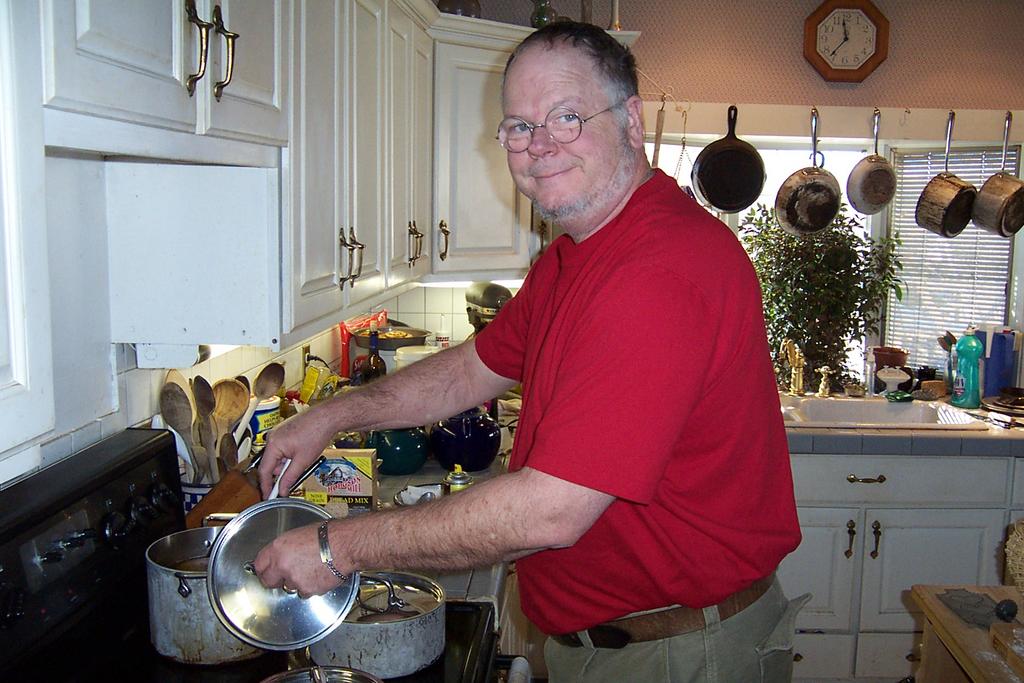
I heard about the Slow Food movement a few years ago. It was begun as a statement against the proliferation of fast food in our society. A good history of the movement and its mission can be found at this web site. The idea of "slow food" goes hand in hand with a journey to simplicity. And fortunately, I have a live-in chef who is an expert at slow food! He detests processed foods and tries to make everything from scratch. He buys organic if possible. He can take some onions, some colorful peppers, some fresh garlic and other seasonings, a little meat, some fresh spinach - mmmm! He doesn't use recipes. Everything is in his head, which makes it hard to write his delicious concoctions down for the kids, who, now grown, want to cook like Daddy.
All I can say is - the fact that my husband has done all the cooking for the family for our 31 years of married life - including Thanksgiving and Christmas holidays - definitely helps make my life simple! Thanks, Ed!
Friday, July 01, 2005
Back to nature
My husband Ed says that one reason society is so screwed up today is that we have removed ourselves more and more from nature. He thinks humans are meant to commune with nature, that we actually are part of nature and thus nature complements us. He says that every step of processing our food, for instance, is one more step away from food as nature made it. He said touching a tree soothes the soul, being out on a sunny day improves the disposition, and the changing of the fall leaves renews one's spirit.
I've thought about his ideas lately because in Maine at this time of year people try to get back to nature. Around here, the primary objective for tourists is, of course, Acadia National Park. Each summer the cars with out-of-state licenses are lined up for miles, aiming for those beautiful acres of forest and mountains on the ocean's edge.
Ed loves to hike. One day he hiked in Acadia, got lost, and ended up hiking for 8 hours on what was supposed to be a 2-hour walk. I once agreed to go on a "walk" with him at Acadia. I soon found out that a "walk" to me and a "walk" to him were two different things. He hikes for hours, and I like to walk as fast as I can for 15 minutes, then turn around and head back. Thirty minutes of exercise. Needless to say, after my complaining and his complaining about my complaining, we agreed that day that we would share other activities but never go "walking" together again.
I do love nature. I really do! At a distance. Through a window, or at least a screen. I realize now that any journey to simplicity must involve a truce between me and nature. I freely admit this will be difficult for me. So what do I have against nature? It's either too hot or too cold or too wet or too humid or too windy. I don't like dirt or mud either. Those "mud pies" we used to make in the backyard using little foil pot-pie cups have lost their allure.
I absolutely hate bugs, although they love me. The Maine blackfly effects some kind allergic reaction in me and I swell up at the site of its attack. Flowers are gorgeous, but where there are flowers there are bees. Yes, I know bees perform a valuable humanitarian service, one that is necessary for ecological purposes, but when I was a little girl I had a bee fly up my sleeve at recess on the playground at East Elementary School and since then bees have made me quite nervous. It didn't help matters when a couple of years ago I was taking a walk down a country road and a bee chased me for a good mile. I didn't know I could run that fast. See - even when I try to get back to nature, I am thwarted.
Ed used to preach that when God told Moses to take off his shoes, that he was on holy ground, it was not so much about the fact his shoes would desecrate the ground - it was that Moses needed his bare feet to be in direct contact with the ground so the "current of holiness" could go through his body. Now me, I never go barefoot outside. I am glad God has never asked me to do so. Our son-in-law is constantly amused at our insistence on wearing shoes. He's not a hillbilly - he's an educated teacher - but he was raised to run barefoot all summer. The idea just freaks me out. There are so many things that would be dangerous to step on, and eww...the dirt and mud!
Jesus said we must become like little children, and that's one thing kids do enjoy - the outdoors and nature in all her glory. And somewhere in my inner child I remember walking home from school, going by the Pink Palace museum and climbing up onto a low-lying branch of the deodar tree (I know it was a deodar tree because it had a plaque on it stating that fact) and just resting there, mulling over the events of the day, and - yes - talking to the tree. Since I have grown up, I am, like many other adults, a fan of the creature comforts in life: Heat, air conditioning, floors, walls, windows and screens. And comfy chairs to sit in so when you get up you won't have wet grass and dirt on your pants.
I think this is a good goal for Caroline to help me with.
I've thought about his ideas lately because in Maine at this time of year people try to get back to nature. Around here, the primary objective for tourists is, of course, Acadia National Park. Each summer the cars with out-of-state licenses are lined up for miles, aiming for those beautiful acres of forest and mountains on the ocean's edge.
Ed loves to hike. One day he hiked in Acadia, got lost, and ended up hiking for 8 hours on what was supposed to be a 2-hour walk. I once agreed to go on a "walk" with him at Acadia. I soon found out that a "walk" to me and a "walk" to him were two different things. He hikes for hours, and I like to walk as fast as I can for 15 minutes, then turn around and head back. Thirty minutes of exercise. Needless to say, after my complaining and his complaining about my complaining, we agreed that day that we would share other activities but never go "walking" together again.
I do love nature. I really do! At a distance. Through a window, or at least a screen. I realize now that any journey to simplicity must involve a truce between me and nature. I freely admit this will be difficult for me. So what do I have against nature? It's either too hot or too cold or too wet or too humid or too windy. I don't like dirt or mud either. Those "mud pies" we used to make in the backyard using little foil pot-pie cups have lost their allure.
I absolutely hate bugs, although they love me. The Maine blackfly effects some kind allergic reaction in me and I swell up at the site of its attack. Flowers are gorgeous, but where there are flowers there are bees. Yes, I know bees perform a valuable humanitarian service, one that is necessary for ecological purposes, but when I was a little girl I had a bee fly up my sleeve at recess on the playground at East Elementary School and since then bees have made me quite nervous. It didn't help matters when a couple of years ago I was taking a walk down a country road and a bee chased me for a good mile. I didn't know I could run that fast. See - even when I try to get back to nature, I am thwarted.
Ed used to preach that when God told Moses to take off his shoes, that he was on holy ground, it was not so much about the fact his shoes would desecrate the ground - it was that Moses needed his bare feet to be in direct contact with the ground so the "current of holiness" could go through his body. Now me, I never go barefoot outside. I am glad God has never asked me to do so. Our son-in-law is constantly amused at our insistence on wearing shoes. He's not a hillbilly - he's an educated teacher - but he was raised to run barefoot all summer. The idea just freaks me out. There are so many things that would be dangerous to step on, and eww...the dirt and mud!
Jesus said we must become like little children, and that's one thing kids do enjoy - the outdoors and nature in all her glory. And somewhere in my inner child I remember walking home from school, going by the Pink Palace museum and climbing up onto a low-lying branch of the deodar tree (I know it was a deodar tree because it had a plaque on it stating that fact) and just resting there, mulling over the events of the day, and - yes - talking to the tree. Since I have grown up, I am, like many other adults, a fan of the creature comforts in life: Heat, air conditioning, floors, walls, windows and screens. And comfy chairs to sit in so when you get up you won't have wet grass and dirt on your pants.
I think this is a good goal for Caroline to help me with.
Friday, June 24, 2005
Master of Everything?
One of my personal blocks to achieving simplicity is simply the fact I have way too many interests. Anyone who knows me well knows I have too much I want to learn. My amazing parents instilled in me a sense of wonder and curiosity about the world. I also inherited their pride in a sense of accomplishment and work well done. I don't think I have been very effective in meshing those two ideas into a workable lifestyle.
There are some things I just want to know about because they fascinate me. These involve just facts, and they would require a certain amount of time to research and read about. Some questions, I know, I've bothered various family members with but still can't understand:
How do planes get up in the air and stay up? How do telephones work? How do microchips work? How can Google take one second to research a million sites? How can an ink cartridge in a printer spit out such precise patterns? How can people build such tall buildings? Why can't we predict earthquakes? How do they decaffeinate coffee and tea? How can you freeze human embryos without damaging them? How can telescopes see far into the galaxy? How does an electron microscope work? How do we know what an atom consists of? What is electricity?
How do they get glue in tubes? How do cameras work? How do headache medicines know it's your head that is hurting and not your foot?
Then there are other things I want to learn that are skills. I would like to be able to play the violin, the cello, and a wind instrument. I would like to be able to smock and to knit. I want to be able to do incredibly realistic-looking photo manipulation. I would love to learn to make wood furniture. I wish I could professionally frame pictures, refinish floors, and install carpet. I wish I could garden like my sister can. These too would require inordinate amounts of time to learn - just the basics. What time would I need to master them? Some people practice all their lives to perfect these skills!
The problem essentially comes down to one question. I have asked myself this question for years and cannot come up with a satisfactory answer. Would I rather be brilliantly proficient at one or two things in life, or would I rather be moderately competent in lots of things? Because it doesn't look like I can do everything wonderfully. Such a dilemma for a perfectionist! Such a conundrum for one who is determined to simplify.
Just think - If I concentrated only on quilting and let everything else go - what I could accomplish! The beauty I could create! The quantity of quilts I could make! The creativity I could release! I would be a master at quilting - but I would miss cross-stitching, singing, playing the piano, playing the harp, working with photography, making my own greeting cards, writing poems...
Sometimes I feel that I have made the decision to not make the decision - and that means I default to being moderately competent in lots of things. At least that's where I am now.
And I still don't understand how I can pick up a telephone in Maine and talk to my mother in Memphis. It's just too weird.
There are some things I just want to know about because they fascinate me. These involve just facts, and they would require a certain amount of time to research and read about. Some questions, I know, I've bothered various family members with but still can't understand:
How do planes get up in the air and stay up? How do telephones work? How do microchips work? How can Google take one second to research a million sites? How can an ink cartridge in a printer spit out such precise patterns? How can people build such tall buildings? Why can't we predict earthquakes? How do they decaffeinate coffee and tea? How can you freeze human embryos without damaging them? How can telescopes see far into the galaxy? How does an electron microscope work? How do we know what an atom consists of? What is electricity?
How do they get glue in tubes? How do cameras work? How do headache medicines know it's your head that is hurting and not your foot?
Then there are other things I want to learn that are skills. I would like to be able to play the violin, the cello, and a wind instrument. I would like to be able to smock and to knit. I want to be able to do incredibly realistic-looking photo manipulation. I would love to learn to make wood furniture. I wish I could professionally frame pictures, refinish floors, and install carpet. I wish I could garden like my sister can. These too would require inordinate amounts of time to learn - just the basics. What time would I need to master them? Some people practice all their lives to perfect these skills!
The problem essentially comes down to one question. I have asked myself this question for years and cannot come up with a satisfactory answer. Would I rather be brilliantly proficient at one or two things in life, or would I rather be moderately competent in lots of things? Because it doesn't look like I can do everything wonderfully. Such a dilemma for a perfectionist! Such a conundrum for one who is determined to simplify.
Just think - If I concentrated only on quilting and let everything else go - what I could accomplish! The beauty I could create! The quantity of quilts I could make! The creativity I could release! I would be a master at quilting - but I would miss cross-stitching, singing, playing the piano, playing the harp, working with photography, making my own greeting cards, writing poems...
Sometimes I feel that I have made the decision to not make the decision - and that means I default to being moderately competent in lots of things. At least that's where I am now.
And I still don't understand how I can pick up a telephone in Maine and talk to my mother in Memphis. It's just too weird.
Thursday, June 16, 2005
Button, button, who's got the button?
It would help us simplifiers if the manufacturing industry came "down" to our standards. I am constantly amazed at how many "bells and whistles" component every technological product has to possess. I realize it is now an old joke about nobody being able to program the VCR, but the pattern is truly insidious.
I have what was in the late 1980s a top-of-the-line computer sewing machine. I still don't know how to use all its features. And I don't sew often enough to remember them when I learn them.
Every time I have to sew a buttonhole, I must take out the instruction manual and look up the instructions. I have presser feet and specialized attachments I not only will never use - I haven't even learned what they are for.
In spite of all the wonderful tasks my serger will perform, I still use it mainly for finishing seams - and for you sewing-impaired readers, that is like asking Meryl Streep to act in a first-grade play.
We bought a new smaller microwave so it takes up less counter space in the kitchen while we are trying to sell the house. Does anyone really use all those features? Sheesh! I was trying to explain to Ed, my resident culinary expert, how to cook bacon in the microwave, and he dismissed my whole lecture, saying, "I don't want to know that stuff. All I use the microwave for is defrosting and heating up food and drinks."
I'm currently on a rampage about how they make remotes. Like most families, we have several remotes - TV remotes, VCR/DVD remotes, stereo remotes...even a remote to turn on a ceiling fan and light. Each remote is different, and each time I have to complicate my life by trying to remember how each one works. I know there are "universal" remotes out there but they are just as bad and I have never been able to get them to work right. Yet these remotes are supposed to be simplifying our life by allowing our lazy selves to manipulate the machine without getting up. I suspect our kids can't even remember the days we had to get up and walk over to the TV and actually change a channel manually.
The cordless phone is another "miracle of technology." What was that Paul said in the Bible? He doesn't do what he wants to do, and does what he doesn't want to do? Yeah, my cordless phone is the same way. It has functions I will never use and never learn, yet the function I use the most, storing numbers in the digital phone book, limits itself to 30 numbers. Let me tell you, I can list 30 numbers I need to store in less than a minute - and have numbers I still want to add - but I'm limited to 30. The rest I will have to look up or memorize, I guess. And this is simplifying?
The cell phone is no better. There are apparently a few buttons on the side of the thing that I am accidentally pushing when I handle the phone. I think one of them turns off the ringer, but I'm not sure. How in the heck does one pick up a tiny phone like that and not push anything on the outside?
The CD player in my Toyota is another wonder of technology. I still can't remember how to skip a track, etc., without pushing several buttons. Not good when I'm driving.
So is technology simplifying our lives or making them more complicated? Are we more productive? Are we less or more stressed?
I will admit here that, with all my recent rants about clocks, it gives me some satisfaction to look on the wall and see basically the same kind of simple clock I grew up with. Round, 12 numbers, 2 big hands, one little hand. It even has the same numbers I grew up watching. I'm so glad they didn't change the numbers. It's nice that some things never change...not yet, anyway.
I have what was in the late 1980s a top-of-the-line computer sewing machine. I still don't know how to use all its features. And I don't sew often enough to remember them when I learn them.
Every time I have to sew a buttonhole, I must take out the instruction manual and look up the instructions. I have presser feet and specialized attachments I not only will never use - I haven't even learned what they are for.
In spite of all the wonderful tasks my serger will perform, I still use it mainly for finishing seams - and for you sewing-impaired readers, that is like asking Meryl Streep to act in a first-grade play.
We bought a new smaller microwave so it takes up less counter space in the kitchen while we are trying to sell the house. Does anyone really use all those features? Sheesh! I was trying to explain to Ed, my resident culinary expert, how to cook bacon in the microwave, and he dismissed my whole lecture, saying, "I don't want to know that stuff. All I use the microwave for is defrosting and heating up food and drinks."
I'm currently on a rampage about how they make remotes. Like most families, we have several remotes - TV remotes, VCR/DVD remotes, stereo remotes...even a remote to turn on a ceiling fan and light. Each remote is different, and each time I have to complicate my life by trying to remember how each one works. I know there are "universal" remotes out there but they are just as bad and I have never been able to get them to work right. Yet these remotes are supposed to be simplifying our life by allowing our lazy selves to manipulate the machine without getting up. I suspect our kids can't even remember the days we had to get up and walk over to the TV and actually change a channel manually.
The cordless phone is another "miracle of technology." What was that Paul said in the Bible? He doesn't do what he wants to do, and does what he doesn't want to do? Yeah, my cordless phone is the same way. It has functions I will never use and never learn, yet the function I use the most, storing numbers in the digital phone book, limits itself to 30 numbers. Let me tell you, I can list 30 numbers I need to store in less than a minute - and have numbers I still want to add - but I'm limited to 30. The rest I will have to look up or memorize, I guess. And this is simplifying?
The cell phone is no better. There are apparently a few buttons on the side of the thing that I am accidentally pushing when I handle the phone. I think one of them turns off the ringer, but I'm not sure. How in the heck does one pick up a tiny phone like that and not push anything on the outside?
The CD player in my Toyota is another wonder of technology. I still can't remember how to skip a track, etc., without pushing several buttons. Not good when I'm driving.
So is technology simplifying our lives or making them more complicated? Are we more productive? Are we less or more stressed?
I will admit here that, with all my recent rants about clocks, it gives me some satisfaction to look on the wall and see basically the same kind of simple clock I grew up with. Round, 12 numbers, 2 big hands, one little hand. It even has the same numbers I grew up watching. I'm so glad they didn't change the numbers. It's nice that some things never change...not yet, anyway.
Monday, June 13, 2005
Time...and time again
Time....I can't escape it, but I can't seem to make peace with it. When I was a child taking piano lessons, I had to play a song about a grandfather clock. I looked up the lyrics today:
I have previously written about my bumpy relationship with time, but lately I have noticed an exacerbation of one of my worst traits - wishing time away. It is such a horrible thing to do that I hesitate even to admit it. And the worst thing about it is - I must be successful, because every Thursday when I leave work for my weekend of Friday and Saturday, I think, "The weeks are going faster and faster...time is slipping by me." Yet, on Sunday through Wednesday, I spend much of the day watching the clock and getting irritated by the slow movement of its hands.
I have come to the realization that these days I hold the majority of my conversations with clocks. I get to work about 5:30 a.m., so about 8:00 I start wishing the time away. The clock is right over my computer. I am an excellent conversationalist, and I hold my own weight in the dialogue spinning around in my head. (The clock, however, never has much to offer on its end other than its relentless "tick tock.") Isn't it lunch yet? No, it's 9:00. Just 9:00?! It ought to be at least 10 by now! Then when I get home for lunch at 10:30, I start up my conversation with the living room clock. Whoa, there, slow down, buddy! I'm trying to eat lunch here! I'm trying to relax! Why do you have to be so efficient now? At work you were dragging your feet (OK...hands) and now that I'm home for lunch, you seem to finally summon up some energy.
Maybe my work clock is low on batteries. Maybe my home clock takes vitamins.
Maybe it's just me, but I don't like the idea of wishing away minutes, hours, and days of my life.
Sure, I'd rather be home than at work. Yes, I like my job all right, but at times it can be boring and stressful, and, again, I'd rather be home even on a good workday.
I have to keep myself in the moment. I have to realize that every moment is a gift from God. I have to somehow learn the art of being able to look forward to the future without pining for it, and in the process losing sight of the "now." Even when the "now" is uncomfortable, stressful, or just plain boring.
Tick-tock. The clocks are mocking me. They're getting ready to usurp the dandelions.
Written By: Henry Clay Work
Copyright Unknown
My grandfather's clock
Was too large for the shelf,
So it stood ninety years on the floor;
It was taller by half
Than the old man himself,
Though it weighed not a pennyweight more.
It was bought on the morn
Of the day that he was born,
And was always his treasure and pride;
But it stopped short
Never to go again,
When the old man died.
Ninety years without slumbering,
Tick, tock, tick, tock,
His life seconds numbering,
Tick, tock, tick, tock,
It stopped short
Never to go again,
When the old man died.
In watching its pendulum
Swing to and fro,
Many hours had he spent while a boy;
And in childhood and manhood
The clock seemed to know,
And to share both his grief and his joy.
For it struck twenty-four
When he entered at the door,
With a blooming and beautiful bride;
But it stopped short
Never to go again,
When the old man died.
Ninety years without slumbering,
Tick, tock, tick, tock,
His life seconds numbering,
Tick, tock, tick, tock,
It stopped short
Never to go again,
When the old man died.
My grandfather said
That of those he could hire,
Not a servant so faithful he found;
For it wasted no time,
And had but one desire,
At the close of each week to be wound.
And it kept in its place,
Not a frown upon its face,
And its hand never hung by its side.
But it stopped short
Never to go again,
When the old man died.
Ninety years without slumbering,
Tick, tock, tick, tock,
His life seconds numbering,
Tick, tock, tick, tock,
It stopped short
Never to go again,
When the old man died.
It rang an alarm
In the dead of the night,
An alarm that for years had been dumb;
And we knew that his spirit
Was pluming his flight,
That his hour of departure had come.
Still the clock kept the time,
With a soft and muffled chime,
As we silently stood by his side.
But it stopped short
Never to go again,
When the old man died.
Ninety years without slumbering,
Tick, tock, tick, tock,
His life seconds numbering,
Tick, tock, tick, tock,
It stopped short
Never to go again,
When the old man died.
I have previously written about my bumpy relationship with time, but lately I have noticed an exacerbation of one of my worst traits - wishing time away. It is such a horrible thing to do that I hesitate even to admit it. And the worst thing about it is - I must be successful, because every Thursday when I leave work for my weekend of Friday and Saturday, I think, "The weeks are going faster and faster...time is slipping by me." Yet, on Sunday through Wednesday, I spend much of the day watching the clock and getting irritated by the slow movement of its hands.
I have come to the realization that these days I hold the majority of my conversations with clocks. I get to work about 5:30 a.m., so about 8:00 I start wishing the time away. The clock is right over my computer. I am an excellent conversationalist, and I hold my own weight in the dialogue spinning around in my head. (The clock, however, never has much to offer on its end other than its relentless "tick tock.") Isn't it lunch yet? No, it's 9:00. Just 9:00?! It ought to be at least 10 by now! Then when I get home for lunch at 10:30, I start up my conversation with the living room clock. Whoa, there, slow down, buddy! I'm trying to eat lunch here! I'm trying to relax! Why do you have to be so efficient now? At work you were dragging your feet (OK...hands) and now that I'm home for lunch, you seem to finally summon up some energy.
Maybe my work clock is low on batteries. Maybe my home clock takes vitamins.
Maybe it's just me, but I don't like the idea of wishing away minutes, hours, and days of my life.
Sure, I'd rather be home than at work. Yes, I like my job all right, but at times it can be boring and stressful, and, again, I'd rather be home even on a good workday.
I have to keep myself in the moment. I have to realize that every moment is a gift from God. I have to somehow learn the art of being able to look forward to the future without pining for it, and in the process losing sight of the "now." Even when the "now" is uncomfortable, stressful, or just plain boring.
Tick-tock. The clocks are mocking me. They're getting ready to usurp the dandelions.
Tuesday, June 07, 2005
The Whitten Road Property
Two months and counting and still no offer on the house. Ed is having phone consults with Ritchie from Coastline Homes about every other day regarding the plans for the new house. Ed designed a modular home that will be perfect for our lifestyle and Coastline has taken his ideas and transformed them into architectural scale drawings. It's strange to see a house plan out of Ed's head take shape on paper.
We haven't built the new house yet, of course; we haven't even bought the property. We are "holding" the property - almost 3 acres of land in Hancock. That is where our hearts are, but our wallets can't get involved until we sell this house. This puts us in a kind of limbo. Limbo is not a pleasant place to stay for any length of time - trust me. The state of limbo is not conducive to patience. It instigates arguments. When one is in limbo, one is kept off balance just enough that moods alternate between fear and pessimism. Occasionally limbo will erupt into sheer panic. Gurunet defines limbo in this way:
Lately we have begun to call our 3 acres in Hancock "The Whitten Road Property." This may seem strange when you learn that it is not located on Whitten Road. It is not even near a Whitten Road. There's a story behind this, of course.
When we were living in Memphis, we joined a small Episcopal Church in the heart of the city. After we got involved in the functions of the church, we would always hear talk about The Whitten Road Property. It was discussed at coffee hour. It was on the agenda at meetings. It was mentioned in the announcements. We finally learned that this church, located well inside the city limits of Memphis, had several years prior bought some acreage on the outskirts of Memphis on Whitten Road with the intentions of one day moving the congregation out there. They never took specific steps to do that, but the intention was always clear that "in the future" they would build a new church on The Whitten Road Property. With all the talk, though, we got the feeling that it would never happen. It became almost like a joke to Ed and me. Decades - yes, decades later - they still have not moved. We occasionally wonder if maybe they ended up selling The Whitten Road Property. Or maybe that would have admitted defeat, and as long as they owned the land, they would keep hope alive.
Through the years, churches we have attended have blessed us with the opportunity to create countless inside family jokes. This week, it is the Trinity Syndrome that I am reliving.
Trinity United Methodist was another Memphis church. It was a beautiful old building with a graying congregation. The few children who were there stayed in a dingy little nursery in the basement. Finally it was decided that the nursery needed sprucing up. They decided to paint it. This was accomplished speedily with little effort. Uh-oh...the nursery looked great, they said, but did anyone notice how the adjoining hall looked ugly now that the nursery was freshly painted? Well, yes, they did. Something had to be done. So they painted the hall. Can you see where I am going with this story? After the hall, they painted the other basement rooms...and on and on and eventually the church underwent several thousands of dollars' worth of renovation encompassing the entire building including the sanctuary. You have to be careful when you start fixing up. It makes the rest of the area look really drab in comparison.
That's what I'm involved with this week, our 10th week in limbo. I started painting a few places in the house, and I can't seem to find a stopping place.
So I'm stuck in the Trinity Syndrome, thinking all the while about our Whitten Road Property. In the state of limbo, one must keep hope alive!
We haven't built the new house yet, of course; we haven't even bought the property. We are "holding" the property - almost 3 acres of land in Hancock. That is where our hearts are, but our wallets can't get involved until we sell this house. This puts us in a kind of limbo. Limbo is not a pleasant place to stay for any length of time - trust me. The state of limbo is not conducive to patience. It instigates arguments. When one is in limbo, one is kept off balance just enough that moods alternate between fear and pessimism. Occasionally limbo will erupt into sheer panic. Gurunet defines limbo in this way:
Limbo in Roman Catholic theology is located on the border of Hell, which explains the name chosen for it.How apropos, don't you think? Just on the border of hell!
Lately we have begun to call our 3 acres in Hancock "The Whitten Road Property." This may seem strange when you learn that it is not located on Whitten Road. It is not even near a Whitten Road. There's a story behind this, of course.
When we were living in Memphis, we joined a small Episcopal Church in the heart of the city. After we got involved in the functions of the church, we would always hear talk about The Whitten Road Property. It was discussed at coffee hour. It was on the agenda at meetings. It was mentioned in the announcements. We finally learned that this church, located well inside the city limits of Memphis, had several years prior bought some acreage on the outskirts of Memphis on Whitten Road with the intentions of one day moving the congregation out there. They never took specific steps to do that, but the intention was always clear that "in the future" they would build a new church on The Whitten Road Property. With all the talk, though, we got the feeling that it would never happen. It became almost like a joke to Ed and me. Decades - yes, decades later - they still have not moved. We occasionally wonder if maybe they ended up selling The Whitten Road Property. Or maybe that would have admitted defeat, and as long as they owned the land, they would keep hope alive.
Through the years, churches we have attended have blessed us with the opportunity to create countless inside family jokes. This week, it is the Trinity Syndrome that I am reliving.
Trinity United Methodist was another Memphis church. It was a beautiful old building with a graying congregation. The few children who were there stayed in a dingy little nursery in the basement. Finally it was decided that the nursery needed sprucing up. They decided to paint it. This was accomplished speedily with little effort. Uh-oh...the nursery looked great, they said, but did anyone notice how the adjoining hall looked ugly now that the nursery was freshly painted? Well, yes, they did. Something had to be done. So they painted the hall. Can you see where I am going with this story? After the hall, they painted the other basement rooms...and on and on and eventually the church underwent several thousands of dollars' worth of renovation encompassing the entire building including the sanctuary. You have to be careful when you start fixing up. It makes the rest of the area look really drab in comparison.
That's what I'm involved with this week, our 10th week in limbo. I started painting a few places in the house, and I can't seem to find a stopping place.
Sunday, June 05, 2005
It's perfect!
I'll freely admit that I am a perfectionist - in some things, that is. Not in cooking and not in housekeeping, where I will ignore defects in the "finished product." In grammar and spelling and punctuation, however, I demand absolute perfection. No apostrophe where it shouldn't be, and its corollary, an apostrophe where it should be - that's one of my mottos.
Excepting grammar, I have come to realize that sometimes it's hard to determine when something is perfect. Other times, I just feel it. When I create a poem for a homemade greeting card, my rough draft is edited many times before it is finalized. I can't put my finger on it, but I just know when it's perfect. Sometimes that perfection is achieved in a few minutes; sometimes it takes days.
As a quilter, I have always treasured the quilter's tradition of having a deliberate defect or error in an otherwise perfect quilt. According to tradition, the error is a reminder that only God is perfect. Of course, I joke that my quilts contain more than the required defects, and they are definitely not on purpose!
Ed told me once the word "perfect" as used in scripture ("Be perfect, as your Father in heaven is perfect") means not the definition we assume, but means to be whole, complete. To be as it is supposed to be.
Caroline was over here on Friday. She continues to fascinate me in everything she says and does. I feel as if I am growing up all over again with her. (If I let myself loose to act as a kid, though, I am painfully reminded that I am an adult. Those climbing maze-like structures at the playground are definitely not made for a 50-year-old body!) Caroline loves this house. She loves the stairs, she loves the bow windows where she can wave goodbye to her mama, she loves the fact there are so many places to explore.
One of Caroline's favorite pastimes is to play with stickers. By "play," I mean she peels a sticker off its sheet of origin and sticks it on another piece of paper. I think she finds the challenge in this consists of being able to peel the sticker off in one piece without a tear and being able to adhere the sticker permanently to the paper and not her finger. On Friday, she found some stickers in her toybox here, expressed her usual joy over the discovery, excitedly accepted the green sheet of paper I offered her, and got down to business. I helped her peel off the first sticker. After she admired its beauty (which in itself made me chuckle; it was a gargoyle from Hunchback of Notre Dame), she transferred the sticker onto the green sheet of paper. Once it was secure, she inspected it, smiled, and said, "It's perfect!" For the next 15 minutes, she repeated the process, peeling each sticker off its sheet of origin and transferring it to the green sheet, and with utter satisfaction, saying, "It's perfect!" Of course, it wasn't perfect. Some stickers were torn. All were placed in a crooked manner. There was no rhyme or reason to the layout. But to Caroline, the whole thing was perfect. It reminded me so much of Genesis, where after creating the world, God looked at it and said it was good.
The scene was repeated in a way later when she sat on the steps to take off her sandals to prepare for her nap. She took each shoe off, then held her little feet out and wiggled them.
"Perfect!" she said. She reached down and pulled one foot close to her face and inspected it closely. She turned it over to look at the bottom. She did the same thing with her other foot. Then she put her feet together and wiggled her toes. "Perfect!" she repeated with enthusiasm. "I LOVE MY FEET!"
We're trying to get the house perfect so that a potential buyer will fall in love with it. Of course, it will never be perfect, and it is truly far from it. There are some things we will never fix because doing so would cost too much money. One room is a testament to the fact that paint has its limits in beautifying cheap paneling. The carpet we bought to replace the paint-stained carpet in the hallway was installed because it was inexpensive, not because of its color. We tried to clean out the dirt-floor basement yesterday, and I dare say that whoever looked at it would be amazed that we had accomplished anything, because it still looks like it needs a bulldozer.
Yes, this house will never be perfect. We can fall back on the old line that its imperfections give it character. We can remind ourselves that, after all, the house is over 100 years old. Every time I walk through certain areas in the house, I see more that we should/could do. Nothing is ever finished. The task of getting the house ready to sell will never be completed to our satisfaction.
Not to worry. Caroline loves this house just as it is. And she has high standards!
Excepting grammar, I have come to realize that sometimes it's hard to determine when something is perfect. Other times, I just feel it. When I create a poem for a homemade greeting card, my rough draft is edited many times before it is finalized. I can't put my finger on it, but I just know when it's perfect. Sometimes that perfection is achieved in a few minutes; sometimes it takes days.
As a quilter, I have always treasured the quilter's tradition of having a deliberate defect or error in an otherwise perfect quilt. According to tradition, the error is a reminder that only God is perfect. Of course, I joke that my quilts contain more than the required defects, and they are definitely not on purpose!
Ed told me once the word "perfect" as used in scripture ("Be perfect, as your Father in heaven is perfect") means not the definition we assume, but means to be whole, complete. To be as it is supposed to be.
Caroline was over here on Friday. She continues to fascinate me in everything she says and does. I feel as if I am growing up all over again with her. (If I let myself loose to act as a kid, though, I am painfully reminded that I am an adult. Those climbing maze-like structures at the playground are definitely not made for a 50-year-old body!) Caroline loves this house. She loves the stairs, she loves the bow windows where she can wave goodbye to her mama, she loves the fact there are so many places to explore.
One of Caroline's favorite pastimes is to play with stickers. By "play," I mean she peels a sticker off its sheet of origin and sticks it on another piece of paper. I think she finds the challenge in this consists of being able to peel the sticker off in one piece without a tear and being able to adhere the sticker permanently to the paper and not her finger. On Friday, she found some stickers in her toybox here, expressed her usual joy over the discovery, excitedly accepted the green sheet of paper I offered her, and got down to business. I helped her peel off the first sticker. After she admired its beauty (which in itself made me chuckle; it was a gargoyle from Hunchback of Notre Dame), she transferred the sticker onto the green sheet of paper. Once it was secure, she inspected it, smiled, and said, "It's perfect!" For the next 15 minutes, she repeated the process, peeling each sticker off its sheet of origin and transferring it to the green sheet, and with utter satisfaction, saying, "It's perfect!" Of course, it wasn't perfect. Some stickers were torn. All were placed in a crooked manner. There was no rhyme or reason to the layout. But to Caroline, the whole thing was perfect. It reminded me so much of Genesis, where after creating the world, God looked at it and said it was good.
The scene was repeated in a way later when she sat on the steps to take off her sandals to prepare for her nap. She took each shoe off, then held her little feet out and wiggled them.
"Perfect!" she said. She reached down and pulled one foot close to her face and inspected it closely. She turned it over to look at the bottom. She did the same thing with her other foot. Then she put her feet together and wiggled her toes. "Perfect!" she repeated with enthusiasm. "I LOVE MY FEET!"
We're trying to get the house perfect so that a potential buyer will fall in love with it. Of course, it will never be perfect, and it is truly far from it. There are some things we will never fix because doing so would cost too much money. One room is a testament to the fact that paint has its limits in beautifying cheap paneling. The carpet we bought to replace the paint-stained carpet in the hallway was installed because it was inexpensive, not because of its color. We tried to clean out the dirt-floor basement yesterday, and I dare say that whoever looked at it would be amazed that we had accomplished anything, because it still looks like it needs a bulldozer.
Yes, this house will never be perfect. We can fall back on the old line that its imperfections give it character. We can remind ourselves that, after all, the house is over 100 years old. Every time I walk through certain areas in the house, I see more that we should/could do. Nothing is ever finished. The task of getting the house ready to sell will never be completed to our satisfaction.
Not to worry. Caroline loves this house just as it is. And she has high standards!
Friday, June 03, 2005
Attitude Part 2
I'm a complainer, unfortunately. A lot of it is done inside my head; some of it I actually say.
That has been bothering me recently. I think part of the lifestyle I am choosing to adopt is, as Oprah says, "an attitude of gratitude."
The next time I complain about having to get on the treadmill and exercise, I will be thankful that I can walk when others can't.
The next time I complain about my coworkers, I will be thankful I have a good job with great benefits and good pay, when others are out of work and have no insurance.
The next time I complain about having to clean and fix up this house to sell it, I will be thankful I have a roof over my head when others don't.
The next time I complain about gas prices, I will be thankful I have a car that works, when others have no transportation.
The next time I complain about my hair on a "bad hair day," I will be thankful I have a head of hair when there are women losing theirs to chemotherapy.
The next time I complain about a minor health problem, I will be thankful I have my general health when, as a medical transcriptionist, I see on a daily basis reports of horrible diseases and their effects.
The next time I worry about my kids, I will be thankful I was blessed with such wonderful children in the first place.
The next time I say, "I'm starving!" I will be thankful that is a hyperbole.
The next time I complain about Ed's annoying habits, I will be thankful he quit drinking over 20 years ago.
Life is good.
That has been bothering me recently. I think part of the lifestyle I am choosing to adopt is, as Oprah says, "an attitude of gratitude."
The next time I complain about having to get on the treadmill and exercise, I will be thankful that I can walk when others can't.
The next time I complain about my coworkers, I will be thankful I have a good job with great benefits and good pay, when others are out of work and have no insurance.
The next time I complain about having to clean and fix up this house to sell it, I will be thankful I have a roof over my head when others don't.
The next time I complain about gas prices, I will be thankful I have a car that works, when others have no transportation.
The next time I complain about my hair on a "bad hair day," I will be thankful I have a head of hair when there are women losing theirs to chemotherapy.
The next time I complain about a minor health problem, I will be thankful I have my general health when, as a medical transcriptionist, I see on a daily basis reports of horrible diseases and their effects.
The next time I worry about my kids, I will be thankful I was blessed with such wonderful children in the first place.
The next time I say, "I'm starving!" I will be thankful that is a hyperbole.
The next time I complain about Ed's annoying habits, I will be thankful he quit drinking over 20 years ago.
Life is good.
Subscribe to:
Posts (Atom)